Hail Damage to Garage Doors: What North Shore Homeowners Should Check Now
The hail that swept across Chicagoland this spring did not stay south of the city. Plenty of North Shore homeowners woke up to dimpled siding, cracked car glass, and a garage door that looks fine from the curb. The trouble with a garage door is that the dent you can see is rarely the part that costs you. The part you cannot see is.
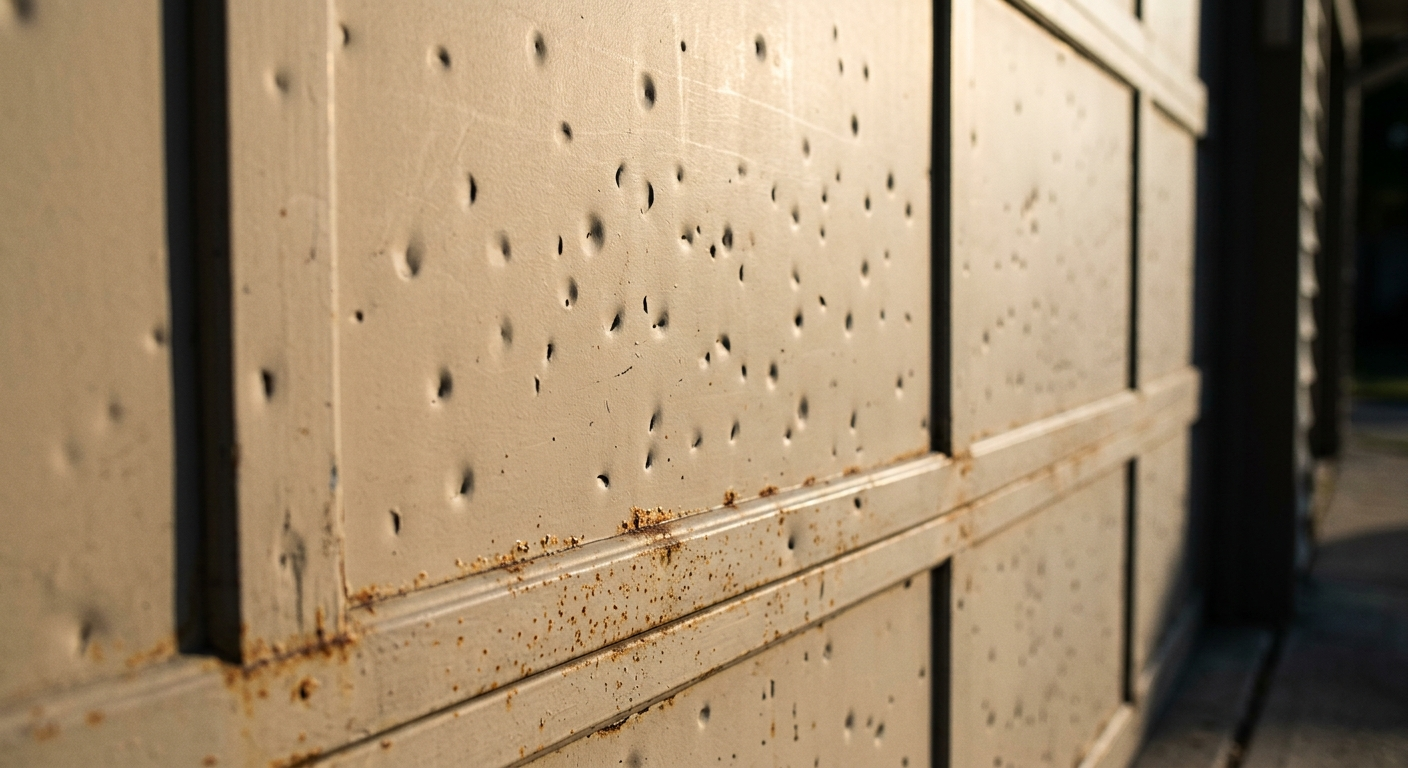
I have spent enough Chicagoland springs pulling panels off the hinges to know the pattern. A homeowner calls because one section looks pockmarked, we get on a ladder, and the real problem turns out to be three feet higher: a section that took a hard hit, flexed, and threw the door slightly out of square. The steel skin recovered. The geometry did not. That is the difference between a door that opens quietly for another decade and one that starts grinding, sticking, and chewing through rollers by July.
If you are anywhere in Cook County and you took 1-inch or larger hail this spring, here is what actually deserves a look, why it matters, and how the insurance side works in Illinois before a deadline quietly closes on you.
Why a garage door takes hail badly
A garage door is a big, thin, hollow target. Most residential doors in Glenview and Northbrook are 25 or 26-gauge steel over a foam or polystyrene core, and the broad flat sections have almost nothing behind them. When a stone the size of a golf ball hits a roof, the decking spreads the load. When it hits a garage panel, the panel absorbs it alone. That is why a door can read worse than the roof above it after the same storm.
Cosmetic dimpling is the obvious result. The quieter damage is structural. A hard strike can push a section into a shallow bow, and once one panel loses its flat plane the whole door stops tracking straight. Add a Midwest winter of freeze-thaw on top of a stressed panel and small problems compound fast. A door that is even slightly out of square in June is a door whose torsion spring is working harder than it was built to all winter.
The seven-point check after a hail storm
You do not need tools for most of this. You need ten minutes, daylight, and a willingness to actually run the door instead of eyeballing it. Work through these in order.
- Look at each section in raking light. Stand at the corner of the door, not in front of it, so the sun rakes across the face. Dimples and bows that vanish head-on jump right out at an angle. Note which sections took the worst of it.
- Run the door and listen. Open and close it twice. A door knocked out of square will hesitate, shudder near the top, or make a new grinding sound it did not make in February. Trust your ears here more than your eyes.
- Check the weather seal along the bottom. The bottom astragal and the side weather seal take direct hail and direct ice. A torn or flattened seal lets snow melt and water sit against the panel and the bottom bracket, where it rusts the cheapest part of the door first.
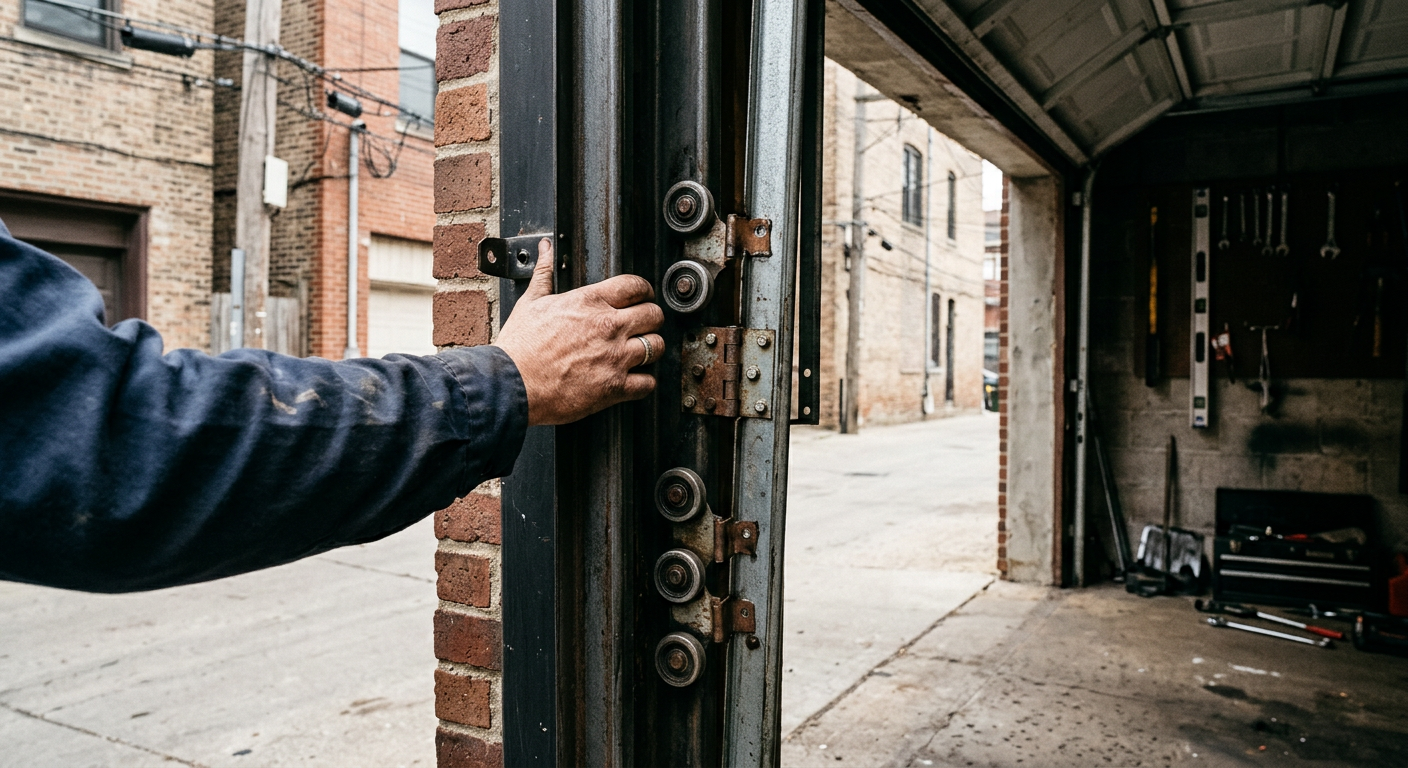
- Eyeball the track alignment. Sight down both vertical tracks. They should be parallel and plumb. A panel that flexed in the storm can tweak a track or loosen its lag bolts, and bad track alignment is what turns a healthy door into a noisy one.
- Inspect the hinges between sections. Each hinge should sit flat with no daylight behind it and no fresh bend. A hinge that is splayed or cracked is a sign a section took a real hit, not just a cosmetic one.
- Pull the manual release and test the balance. With the opener disconnected by the manual release, lift the door halfway by hand and let go. A balanced door holds its place. If it drifts down or springs up, the panel damage has already changed how the door loads the torsion spring, and that is a job for a tech.
- Photograph everything before you touch a thing. Wide shots and tight shots, dated, of every dent and every section. This is your insurance record, and it is worth more the day of the storm than three weeks later.
Repair or replace, honestly
Most hail-damaged residential doors do not need replacing. If the core is sound, the rollers run clean, and the balance holds, a bad section can often be swapped on its own. Garage door sections are sold individually for exactly this reason. We have done plenty of single-panel and two-panel repairs on the North Shore where the homeowner expected a full quote and got a fraction of one.
Replacement earns its keep in a few cases: when several sections are bowed and the door no longer runs square, when an older door was already near the end of its service life, or when the strut and bracket hardware took enough damage that piecemeal repair would cost more than a new door over time. A door that needs a new strut, a new bottom bracket, two sections, and a balance correction is often a door worth replacing outright. The math, not the dent, makes that call. You can see the range on our garage door repair pricing page, and the kind of work it covers across recent Chicago projects.
The Illinois insurance clock is the real deadline
Here is the part homeowners miss until it is too late. The hail did not start a repair clock. It started an insurance clock, and Illinois policy deadlines move faster than people expect. Most homeowner policies require you to report a loss promptly, and Illinois courts have upheld denials where a homeowner waited too long to give notice. Late notice can void otherwise valid coverage, so the day to call your carrier is the week of the storm, not the month you finally book a contractor.
A few practical points for an Illinois claim. Your policy will likely require a signed, sometimes notarized, proof of loss within a set window, often around sixty days. A denial in Illinois has to cite the specific policy language it relies on, so if you get a vague refusal, that is worth questioning. And a documented inspection from a licensed contractor, usually a few hundred dollars, gives an adjuster something concrete to work from instead of a guess. None of this is legal advice, and the source reporting on Illinois hail claims that prompted this piece lays out the statute side in more detail if you want it. Our job is the door in front of you.
Practically, that means two things happen in parallel: you document and report the claim, and you get a real diagnosis of what the storm did to the door. Both have deadlines. The insurance deadline is set by your policy. The repair deadline is set by the first hard freeze, because a stressed panel and a tired torsion spring do not survive a Chicago winter quietly.
What a real inspection covers
When we come out after a storm, we are not just counting dents. We run the door under power and by hand, check the lift cable seating on the drum, confirm the track alignment is still plumb, test the spring balance, and look at every hinge and bracket for the bend that tells us a section took a structural hit. Then we tell you straight whether it is a panel, a repair, or a replacement, and we put it in writing so your adjuster has something solid. You can read more about how we work on our about Windy City Garage page, and there are more storm and winter case files in more from the Journal.
Hail is loud and dramatic, and then it is gone, and the door looks mostly fine, and it is easy to file it under “deal with it later.” The doors that turn into expensive problems are almost always the ones that looked fine in March and got ignored until they failed in December. Ten minutes now, on a clear day, is the cheapest inspection you will ever do.
Frequently asked questions
My garage door only has a few small dents. Do I really need it looked at?
Cosmetic dimpling on its own is often fine, but the only way to know is to run the door and test the balance. If it opens smoothly, holds its place halfway up, and the tracks still sight plumb, a few dents are usually just cosmetic and not urgent. If anything sticks, drifts, or grinds, the strike went past the skin and deserves a real look.
Will my homeowners insurance cover hail damage to the garage door?
Most Illinois homeowner policies cover sudden hail damage, but coverage depends on your specific policy, your deductible, and how promptly you report the loss. Report it to your carrier the week of the storm, photograph everything before any repair, and ask for a written inspection so the adjuster has documentation to work from. Late notice is one of the most common reasons valid claims get denied.
Can a single hail-damaged panel be replaced instead of the whole door?
Yes, in many cases. Garage door sections are sold individually, so a single bowed or dented panel can often be swapped without replacing the entire door, provided the rest of the door still runs square and passes a balance test. Whether a single-panel repair makes sense depends on the age of the door and whether the hardware behind the panel also took damage.
How long do I have to file a hail claim in Illinois?
It depends on your policy, not a single statewide number. Many homeowner policies require prompt notice plus a signed proof of loss within roughly sixty days, while the deadline to actually sue your insurer can be one to two years. Because notice rules are strict and Illinois courts have upheld denials for late reporting, the safe move is to report within days of the storm.
Why does hail damage matter more before winter in Chicago?
A panel that flexed in a hailstorm leaves the door slightly out of square, which makes the torsion spring and rollers work harder than they were built to. Add a Midwest winter of freeze-thaw and snow melt sitting against a torn weather seal, and a small spring-season problem turns into a mid-winter failure. Fixing it on a clear day is far cheaper than a January emergency call.
Took hail this spring? Get a straight read before winter.
We will run the door, test the balance, and tell you honestly whether it is a panel, a repair, or a replacement, with documentation your adjuster can use.
Serving Chicago neighborhoods and the North Shore, from Lincoln Park and Lakeview to Evanston, Skokie, and Oak Park. See the full range of our Chicago garage door services.
