Garage Door Cable Snapped in Chicago? Repair Costs in 2026
The door was already crooked when we pulled into the alley off Lincoln Park. One side sat maybe four inches lower than the other, the bottom panel torqued against the track, and the homeowner was standing in the cold holding a coffee, not sure whether to touch it. A snapped garage door cable does that. It looks alarming, and honestly it should. That thin steel line was holding real weight, and now half the door is hanging on nothing.
If your cable just let go, this is the piece to read before you do anything else. We will walk through what actually broke, what a cable repair runs in the Chicago area in 2026, why the price is not just the cable, and what happens if you leave it and keep hitting the opener button. This is the same explanation we give homeowners in Lakeview, Logan Square, and up into Evanston every week during the cold months.
What a “snapped cable” really is
Your door has two lift cables, one on each side, running from a fitting near the bottom bracket up to a grooved drum at the top corner. When the door is balanced by the spring, those cables wind and unwind off the drums smoothly and take the load. When one snaps, that side loses its support instantly. The door drops, twists, and usually jams itself against the track. That crooked, wedged look is the tell.
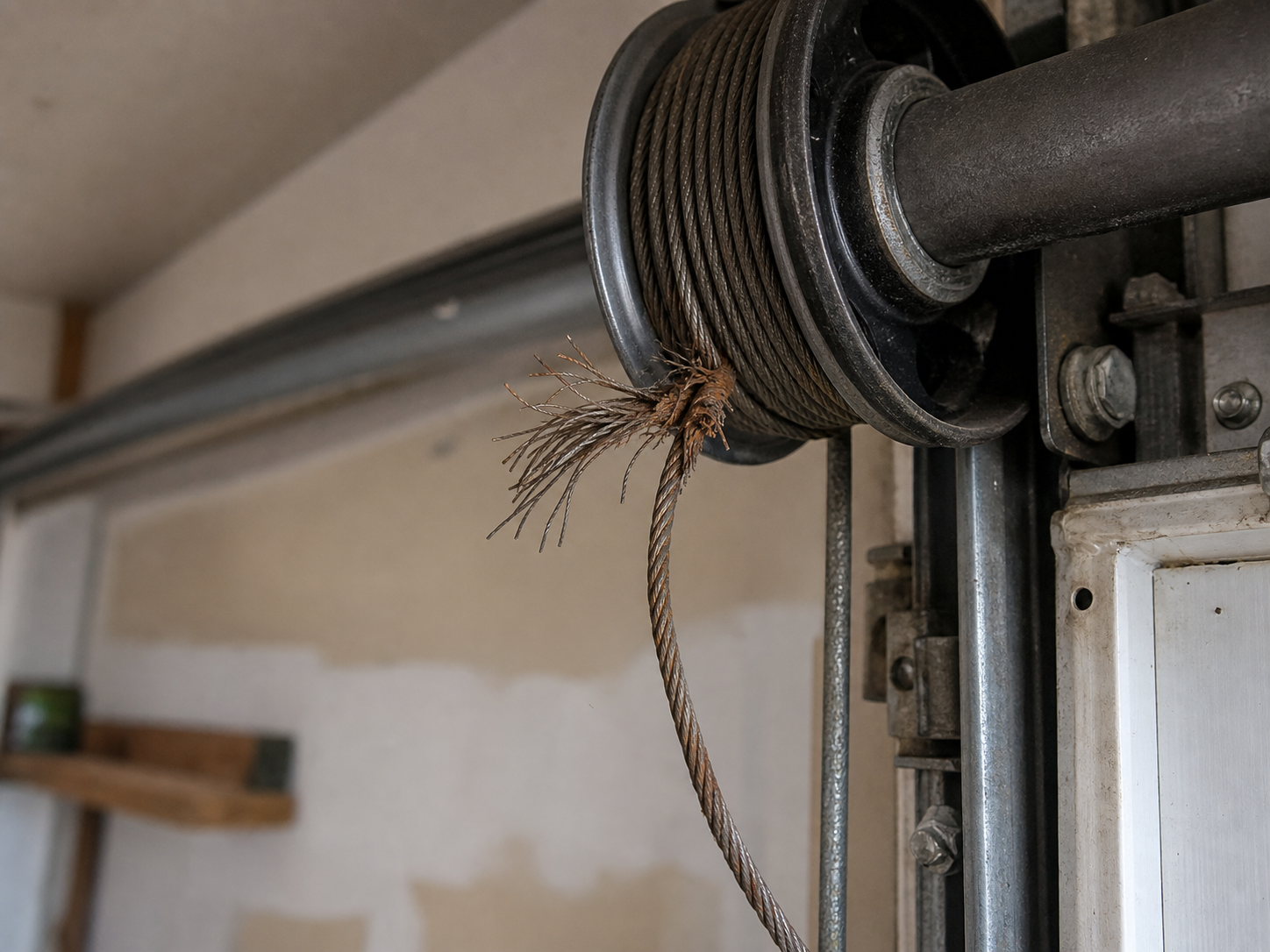
People call it a snapped cable, but the cable is often the last thing to go, not the first. In most of the failures we see, the real story started somewhere else: a spring losing tension, a cable fraying against a rough drum, or rust chewing through the strands near the bottom bracket where alley water and road salt collect. By the time the cable parts, there is usually a second problem hiding behind it. That is the part homeowners do not expect, and it is the reason a cable job is rarely just a cable.
What the repair costs in 2026
Here is the honest range for the Chicago area right now. A straight cable replacement, both sides done as a pair, generally lands in the low-to-mid hundreds. It climbs from there depending on what else the cable took out on its way down, and whether you need it handled after hours.
| Job | Typical 2026 range |
|---|---|
| Lift cable replacement (pair) | $165 to $290 |
| Cable + one cable drum | $240 to $400 |
| Cable + torsion spring (paired) | $360 to $620 |
| Off-track correction after a drop | $180 to $350 |
| After-hours / emergency surcharge | +$75 to $150 |
Why replace cables as a pair when only one broke? Because both sides have the same age, the same weather exposure, and the same wear. If the left one rusted through this winter, the right one is not far behind, and a second trip costs you more than the second cable. It is the same logic we use on torsion springs that snap in the cold: match the pair, do it once.
What moves the price: door weight and height, whether the drum grooves are chewed up, spring condition, rust at the bottom bracket, and time of day. A two-car door in a bungalow-belt garage weighs more than a single, and heavier doors are harder on every cable and drum.
Why it is almost never “just the cable”
When we quote a cable job over the phone and then find something more on site, it is not upselling. It is what the cable was attached to. Three things ride along with a cable failure more often than not.
The drum
The cable winds onto a drum. If the cable jumped the groove and sawed into the drum before it broke, or if the drum is worn, a fresh cable will just fray again on the same rough surface. Sometimes we can dress it. Sometimes the drum has to go too.
The spring
A weak or broken spring shifts load onto the cables that they were never meant to carry alone. In plenty of Chicago garages the spring is the root cause and the cable is the symptom. If the spring is at the end of its cycle life, replacing the cable alone is a short-term fix.
The track and rollers
When a door drops on a failed cable, it slams the panels sideways and can jump the track. Now you have an off-track door on top of the cable. We see this constantly, the same pattern as the bungalow alley case file from a 6 a.m. call last winter. Straightening a bent track section and reseating rollers is its own line on the invoice.
The Chicago winter factor
Cable failures spike here in January and February, and it is not a coincidence. Cook County freeze-thaw cycles are hard on steel. Alley garages take the worst of it: meltwater runs under the door, refreezes at the bottom bracket, and the salt that keeps our streets drivable also eats galvanizing off the cable strands. Add a torsion spring that stiffens and loses a little tension every time the temperature drops below zero, and you get a door working its cables harder than it should, right when the metal is most brittle.
That is why so many of our cold-weather calls across Chicagoland come in as “the door won’t open” and turn out to be a cable that finally gave up after a rough winter humidity swing. If you noticed a fraying cable back in the fall, this is the season it was going to break. Catching a fraying cable at the bottom bracket early is far cheaper than a snapped one plus a jumped track.
What happens if you wait
The honest answer: it gets more expensive and more dangerous, in that order.
With one cable gone, the door is unbalanced. Every time you hit the opener, the good side and the opener rail are carrying load they were never designed to carry alone. That strains the second cable, the opener gear, and the remaining spring. A one-cable job can turn into a cable, a drum, and a bent track inside a week of “just getting it up and down until the weekend.”
The safety side matters more. An unbalanced door can slam down without warning. The manual release becomes the only safe way to move it, and even that takes care when the door is off-balance. We tell every homeowner the same thing: once a cable snaps, stop using the opener. Pull the manual release, leave the door down, and keep kids and cars clear of it until it is fixed.
What to do right now
- Stop pressing the opener. Every cycle on an unbalanced door risks more damage or a sudden drop. Leave it alone.
- Pull the manual release. The red cord disconnects the door from the opener. If the door is safely down, leave it down.
- Do not try to force it level. A door under a broken cable and a loaded spring is not something to muscle by hand. That is how people get hurt.
- Photograph the failure. A quick photo of the loose cable and the drum helps us bring the right parts on the first trip.
- Book a balance test with the repair. A proper fix ends with a balance test so the new cables, spring, and rollers are all sharing the load the way they should.
Cable down? Do not wait for it to get worse.
We handle cable, drum, and off-track repairs across Chicago and the North Shore, including same-day and after-hours calls in the cold months. We will diagnose the real cause, not just swap the part that broke.
Frequently asked questions
Can I drive to work and fix the cable this weekend?
You can, but pull the manual release and leave the door down until then. Running the opener on a door with a snapped cable strains the second cable, the opener, and the spring, and it risks a sudden drop. What starts as a cable repair often turns into a cable plus a bent track and a chewed drum after a few forced cycles. Waiting a couple of days is fine if you stop using the opener. Waiting while still cycling it is what makes the bill grow.
Why do you replace both cables when only one broke?
Both cables are the same age and have taken the same Chicago winter abuse, the same salt, and the same freeze-thaw at the bottom bracket. If one rusted through, the other is close behind. Replacing the pair costs a little more in parts but saves you a second service call within the same season. On a balanced door the cables share the load evenly, so matching them keeps that balance correct and the door tracking straight.
Is a snapped cable the same as a broken spring?
No, but they are related and often travel together. The torsion spring stores the energy that counterbalances the door. The lift cables transfer that force to raise and lower the panels. A weak or broken spring dumps extra load onto the cables, which is a common reason a cable fails. That is why a good technician checks spring tension and cycle life during a cable repair, so you are not paying to fix a symptom while the root cause stays in place.
How long does a cable repair take?
A straightforward pair of lift cables on a residential door usually takes under an hour once we are on site and the door is safely supported. It runs longer if the drum is damaged, the spring needs replacing, or the door jumped the track when the cable let go and needs realigning. We always finish with a balance test and a full cycle to confirm the fix, rather than just getting the door moving and leaving.
Living with a crooked, half-open door through a Chicago January is not something you want to stretch out. A cable is a small part, but it is the part standing between a heavy door and the floor. If yours has gone, get it looked at, see our full garage door repair pricing and Chicago garage door services, browse recent Chicago projects, or read more from the Journal for the next thing likely to wear out.
