Case File / Emergency
It usually happens around 2 a.m. A crack loud enough to sit you straight up in bed, the kind of sound that makes you think someone kicked in the back door. You check the house. Nothing. Then in the morning the garage door won’t budge, or it lifts a foot and drops like it weighs a ton. That bang was your torsion spring letting go, and how you handle the next ten minutes decides whether this stays a cheap fix.
I get this call more than any other in the winter. Lakeview, Logan Square, a bungalow off Milwaukee, an alley garage in Oak Park. The story barely changes. Something exploded in the garage overnight, and now a 200-pound door is sitting on a spring that isn’t there anymore. So let me tell you exactly what broke, whether it’s dangerous, and what to do before you touch anything.
What that bang actually was
Above your garage door, mounted on a steel shaft, sits a tightly wound coil called a torsion spring. That spring, not the opener, does the real lifting. When the door is down, the spring is wound tight and holding a huge amount of stored energy. A standard two-car door runs 150 to 250 pounds, and the spring carries almost all of it. The opener just nudges the last bit.
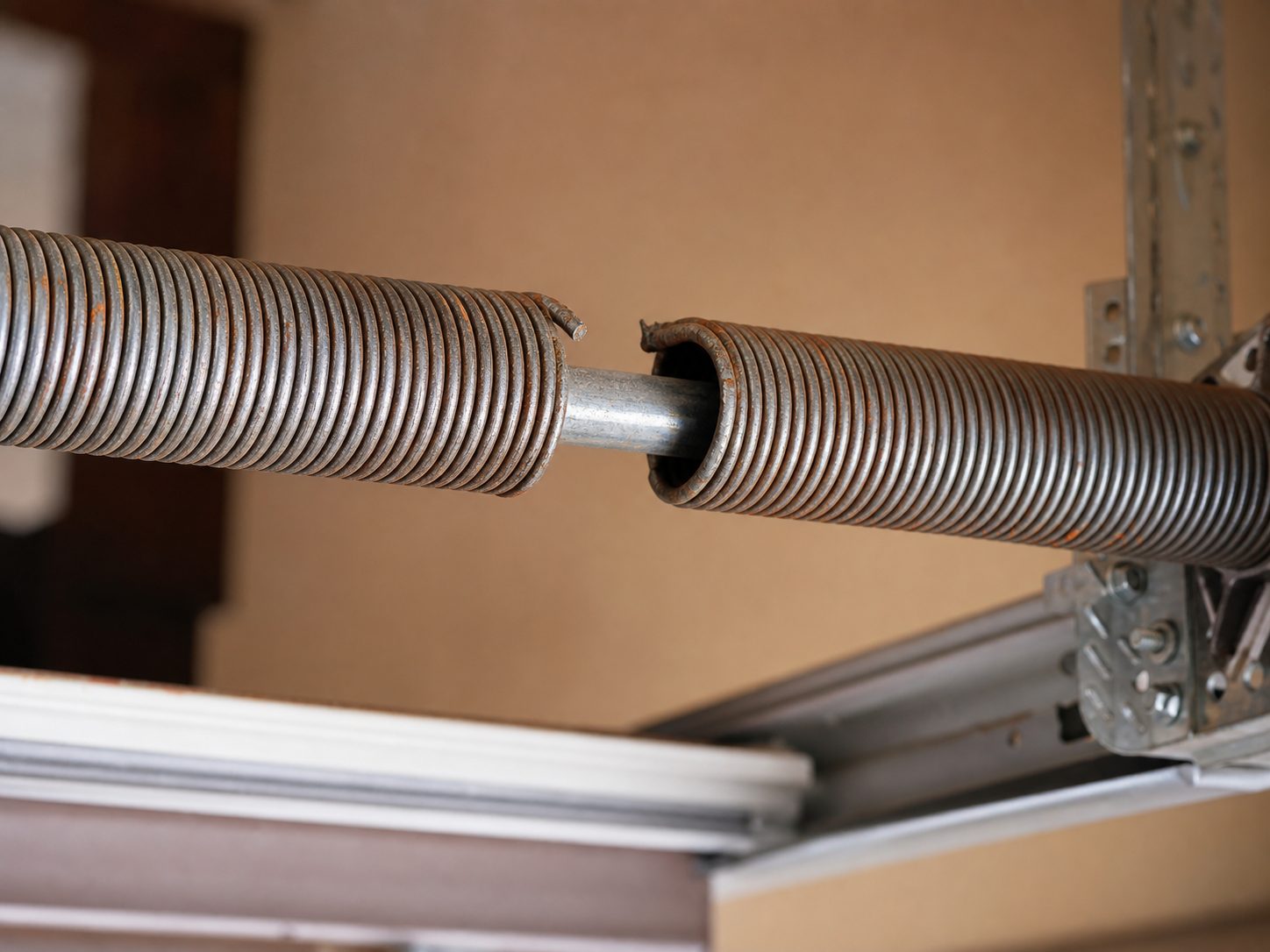
When steel that’s been cycling under that much tension finally fatigues, it doesn’t bend or sag. It snaps clean, and all that stored energy releases in a fraction of a second. That’s the gunshot sound. If you walk out and look at the shaft, you’ll usually see a two or three inch gap in the coil where the spring separated. Sometimes both halves have spun to opposite ends of the shaft. That gap is the whole diagnosis.
Is it dangerous? Here’s the honest answer
The spring already fired. The energy that made the bang is gone, so you’re not standing next to a bomb. But the door is now unbalanced and heavy, and that’s where people get hurt. With no spring holding it, the only things keeping that door up are the lift cable, the drum it winds onto, and the opener’s small motor straining against a load it was never built to carry.
The real danger is a door that comes down fast because nothing is counterbalancing it. I’ve seen a door catch a car hood, and I’ve seen one land on a snow blower. Fingers and feet are the ones that scare me. So the rule for the next ten minutes is simple. Leave it where it is.
Do this right now, in this order
- Do not press the opener button again. Running the motor against a dead spring burns the gears and can snap the cable off the drum, turning one repair into three.
- If the door is down, leave it down. A closed door on a broken spring is a safe door. Park on the street tonight.
- If your car is trapped inside, do not yank the manual release under a raised door. Pulling that red cord on a partially open, unbalanced door lets it slam down. If the door is already fully down, the release is safe to use.
- Keep kids and pets out of the garage until a tech has the door secured. It only takes one bump of the wall button.
How I know it’s the spring and not something else
A few failures sound alike at 2 a.m., so here’s how the diagnosis actually goes. A snapped lift cable makes a sharp twang and the door goes crooked, dropping on one side while the other holds. A torsion spring makes a deeper, flatter bang and the door usually stays level but gets impossibly heavy. A bearing plate or a roller stem failing is more of a grind than a bang.
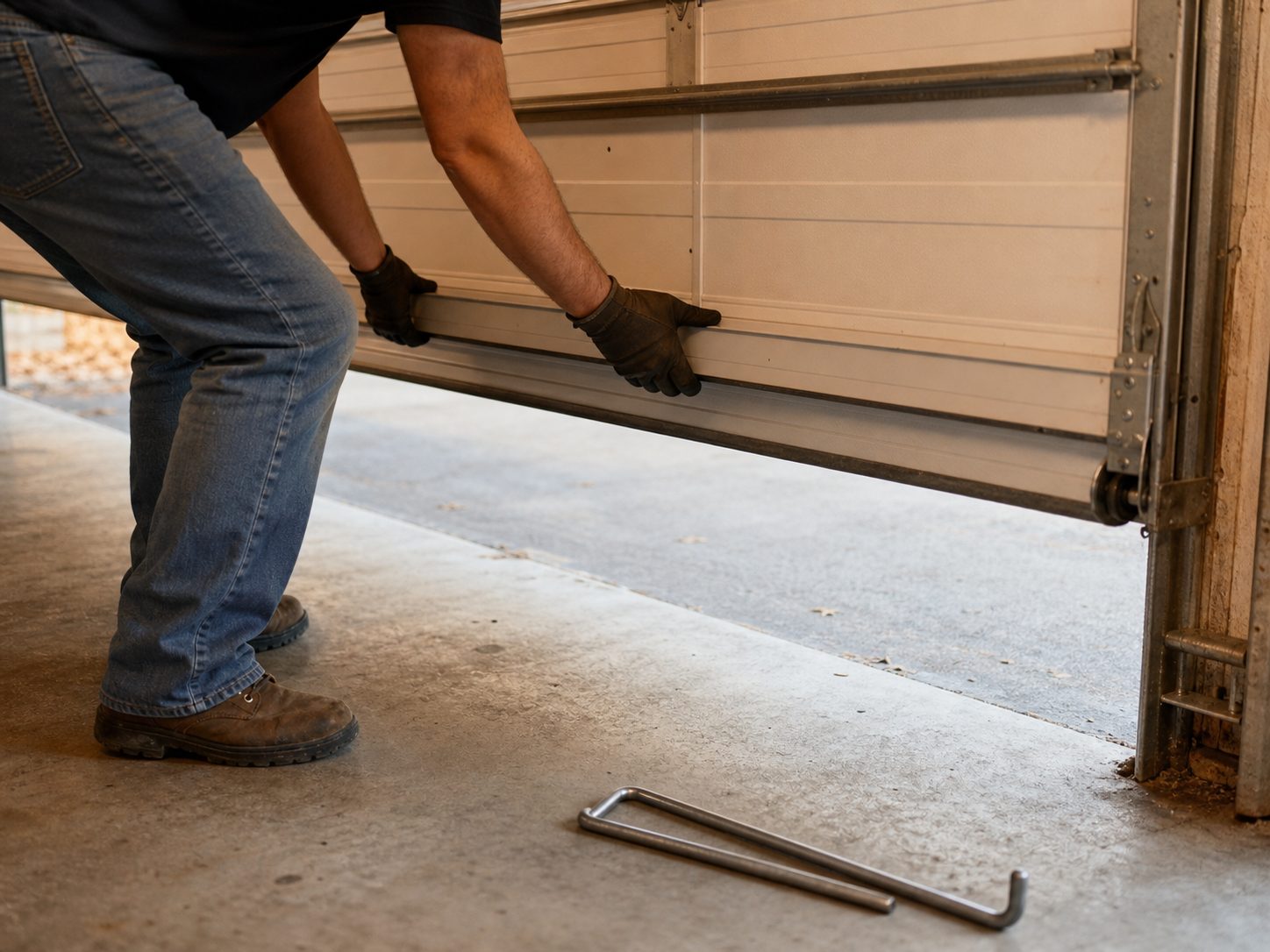
The cleanest field test is the balance test, and you can do a gentle version yourself only if the door is already closed and you never lift it past knee height. Pull the manual release, then try to raise the door by hand a few inches. With a healthy spring it floats and stays put. With a broken one it either won’t move or it fights you the whole way and drops the second you let go. That dead weight is your answer. Re-latch the opener and wait for the tech.
While I’m there I also check the bottom bracket, the cable seating on the drum, and the general track alignment, because a spring that failed hard sometimes takes a cable or a roller with it. It’s worth knowing what else moved so nothing gets missed. If you want to see the range of jobs we handle around the city, our recent Chicago projects give a good picture of what real repairs look like.
Why springs pick the worst night to go
Springs don’t fail at random. Every torsion spring is rated for a spring cycle count, usually around 10,000 cycles for a standard build. One cycle is one up and one down. If your door opens six or eight times a day, you’ll reach that number in roughly seven years, sometimes less on a busy household. When a spring is near the end of its life, the cold finishes the job.
This is a Chicago problem as much as a mechanical one. Below freezing, the galvanized steel in the spring turns more brittle, so metal that used to flex without complaint would rather crack. Add our freeze-thaw swings, the winter humidity that rusts the coil, and a door that’s cycling more because everyone’s rushing in from the cold, and you get the classic Cook County pattern. The spring that was going to fail this spring anyway lets go on the first hard January night instead. If yours is in that age range, our note on more from the Journal covers seasonal prevention worth reading before the deep cold sets in.
One opinion I’ll stand behind: if one spring broke and your door has two, replace both. The second one is the same age and the same fatigue, and it’s usually within months of failing too. Replacing a matched pair now costs a fraction of two separate emergency visits three weeks apart. Any honest tech in Chicagoland will tell you the same thing.
What the repair costs and how fast it happens
A torsion spring is not a homeowner job, and I say that as someone who wants you to save money, not spend it. The winding bars store enough force to break a wrist or worse if they slip, and hardware-store springs are the wrong wire size more often than not. This is the one repair where the right move is to call.
For a straight residential spring replacement in the Chicago area, most jobs land somewhere between 200 and 400 dollars for a single spring installed, and roughly 300 to 550 for a matched pair, depending on the door weight and wire size. A same-day or overnight emergency visit runs higher. If a tech quotes you a new door or a full opener when only a spring broke, that’s your cue to get a second look. You can see how we lay out honest numbers on our garage door repair pricing page, and the full menu on Chicago garage door services if you’re not sure what you need yet.
The repair itself is quick in trained hands. Swap the spring or springs, re-tension to the door’s weight, reset the drum and check the lift cable, run a fresh balance test, and reset the opener’s travel limit and force setting so it’s not fighting anything. Thirty to sixty minutes for most doors. We started Windy City Garage to make that visit fast and straight, and you can read the short version on about Windy City Garage.
A quick one from last winter
Skokie, a Sunday night in February, snow coming down. The homeowner heard the bang, then made the mistake almost everyone makes. He hit the opener three or four times trying to get the door up so he could leave for an early shift. By the time I got there the next morning the spring was in two pieces, the lift cable had jumped the drum, and the opener gear was stripped from grinding against a load it couldn’t move. A single spring swap turned into a spring, a cable reset, and a new gear kit. If he’d walked away after the first bang, it would have been the cheapest of the three. That’s the whole reason I wrote this. The bang is not the expensive part. What you do in the next ten minutes is.
Frequently asked questions
Can I still open my garage door if the spring broke?
Technically the opener might drag it up, but you should not let it. Running the motor against a broken spring puts the full weight of the door on parts that were never meant to carry it, and it commonly snaps the lift cable off the drum or strips the opener gears. Leave the door where it is, park elsewhere for the night, and have the spring replaced before you cycle the door again.
Is it safe to sleep in the house with a broken garage spring?
Yes. The loud bang is the spring releasing its stored energy all at once, and once that’s happened there’s no further sudden risk to people in the home. The remaining hazard is purely mechanical, an unbalanced heavy door that can drop if someone runs the opener or lifts it by hand. Keep everyone out of the garage and you’re fine until a tech arrives.
How long does a garage door spring replacement take?
For a standard residential door in the Chicago area, most spring replacements take thirty to sixty minutes once the technician is on site. That includes swapping the spring or springs, re-tensioning to the exact weight of the door, checking the cable and drum, running a balance test, and resetting the opener’s travel and force so it isn’t straining. Older or oversized doors can take a little longer.
Why did my spring break in the cold when the door was working fine?
Springs fail from accumulated fatigue, not from a single event, and most are rated near 10,000 cycles. When a spring is already near the end of that life, cold weather is the trigger. Below freezing the steel becomes more brittle and our Illinois freeze-thaw swings add stress, so a spring that was months from failing anyway lets go on the first hard cold night instead of in the spring.
Heard the bang? Don’t touch the door.
Leave it where it is and let a Windy City Garage tech get it secured and balanced the right way, usually same day across the city and the North Shore.
Written from the field by the Windy City Garage repair team, serving Chicago neighborhoods and the North Shore.
