A homeowner in Logan Square called us on a Tuesday morning. One torsion spring had let go overnight with a bang that woke the whole house, and the door would not budge. The quote from the first company said replace both springs. She wanted to know why she should pay for the one that still looked fine. Fair question, and the answer is worth understanding before you sign anything.
This comes up on nearly every broken-spring call across Chicagoland, from the bungalow belt on the Northwest Side to the older two-car garages off the alleys in Lincoln Park. One spring snaps, the technician recommends doing both, and the homeowner hears an upsell. Sometimes it is. Most of the time it is the cheaper decision over any honest span of years. Here is how to tell the difference.
The short answer, before the sticker shock
If your door runs on a torsion system with two springs, and one has broken, replace both. It reads like an upsell, but the second spring has taken the exact same beating as the first and it is running on borrowed time. If your door has a single torsion spring, there is nothing to double up on, and you replace the one you have. Extension-spring setups are their own case, and we will get to those.
The reasoning sits in one number: the spring cycle. Every time your door opens and closes, that counts as one cycle, and a standard torsion spring is wound and rated for roughly 10,000 of them. On a busy Cook County household that runs the door six or eight times a day, ten thousand cycles lands somewhere between seven and ten years. Two springs installed on the same day rack up cycles in lockstep. When the first fails at cycle 10,200, the second is sitting at 10,200 too.
Why one snapped spring means the other is already spent
Techs call it the rule of two. Both springs were manufactured in the same batch, wound to the same tension, and mounted on the same shaft on the same afternoon. They lift the same door through the same freeze-thaw swings every Chicago winter. Steel loses a little resilience each cycle, and cold makes brittle metal more brittle, which is why so many springs give out on the first hard January morning. The surviving spring is not healthy. It is simply the one that had not cracked yet when you happened to look.
Leave that second spring in place and you are betting it will outlast a new one by years. It will not. In our experience it follows within weeks or a few months, and now you are paying a second service call, a second diagnostic fee, and a second trip charge to do half the job you could have finished in one visit. The math almost never favors waiting.
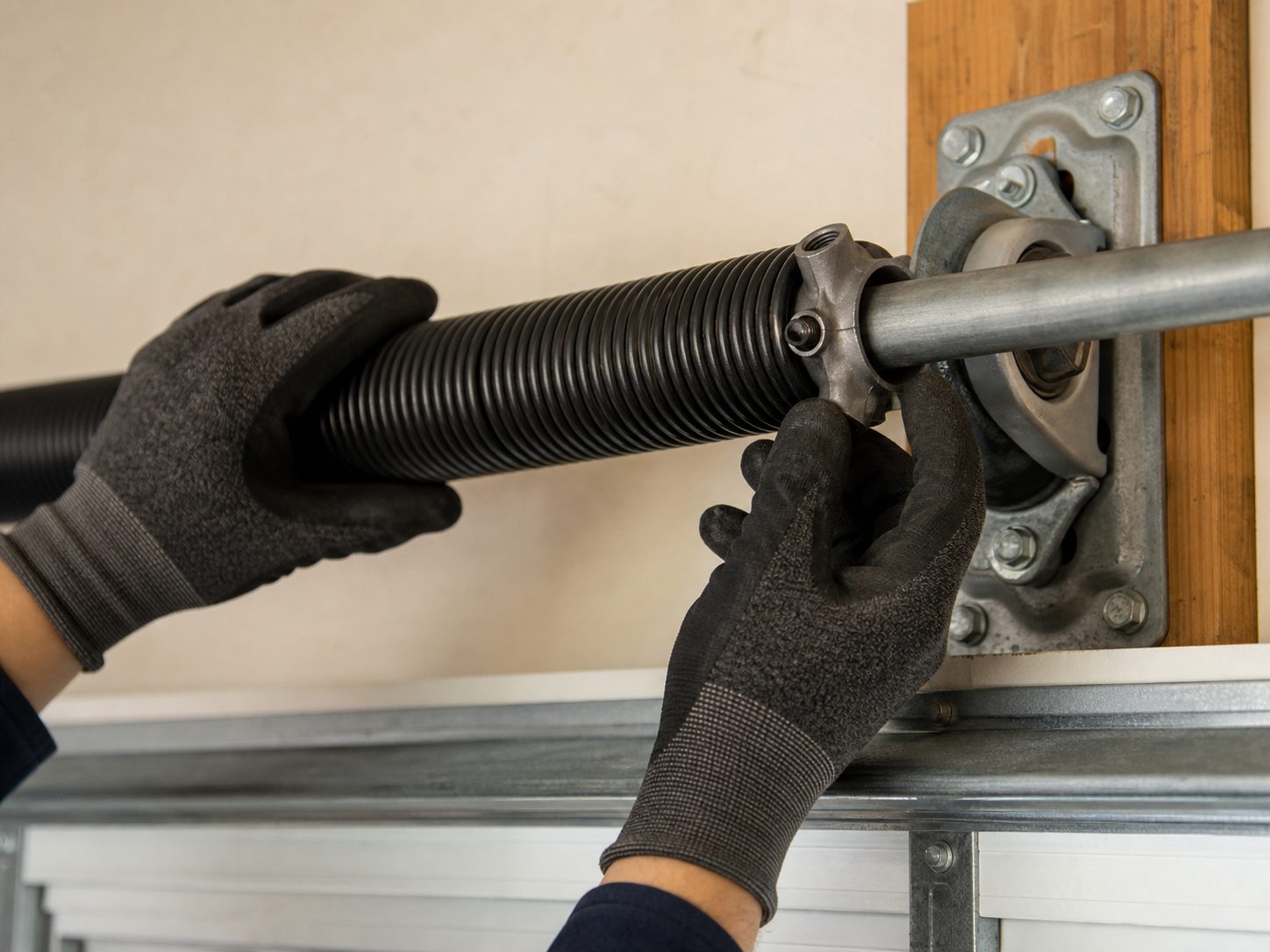
What replacing both actually costs in Chicago
Transparency helps you spot a fair quote, so here are the real ranges we see around the city and the North Shore in 2026. Chicago labor runs a touch higher than the outer suburbs, so expect the top of these bands in the city proper.
Typical spring pricing, parts and labor
- Single torsion spring replacement$180-$280
- Both torsion springs (recommended)$300-$500
- Extension spring pair$150-$250
- High-cycle upgrade (adds)+$50-$100
- Emergency or after-hours (adds)+$75-$125
- Diagnostic fee (often waived with repair)$50-$95
Notice how the two-spring price is not double the single. The bulk of a spring job is the trip, the setup, unwinding the old torsion tension safely with winding bars, and running a proper balance test at the end. The second spring is mostly parts. Doing both in one visit spreads that fixed labor across two springs instead of paying it twice. You can see how we lay this out on our garage door repair pricing page, and there are no surprise line items on the invoice.
The single-spring gamble, run out on the calendar
Say you replace only the broken spring to save a hundred dollars today. Best case, the old spring holds for another year. When it breaks, you pay a fresh diagnostic and trip charge, so your total for two separate visits often lands above what the pair would have cost in one. Worst case is uneven lift: a new, strong spring paired with a tired one pulls the door out of balance, which strains the opener, wears the lift cable and drum, and can jump the cable off the drum entirely.
And there is a safety piece homeowners rarely hear about. With a broken spring the door weighs its full dead load, well over a hundred pounds on a two-car steel door. If you keep hitting the opener button hoping it will lift, you burn the motor. A worn opener that would have run years can cook itself in a week, turning a $250 spring repair into a $600 opener replacement. Do not run the opener on a broken spring, and pull the manual release cord instead.
Torsion versus extension, and why it changes the math
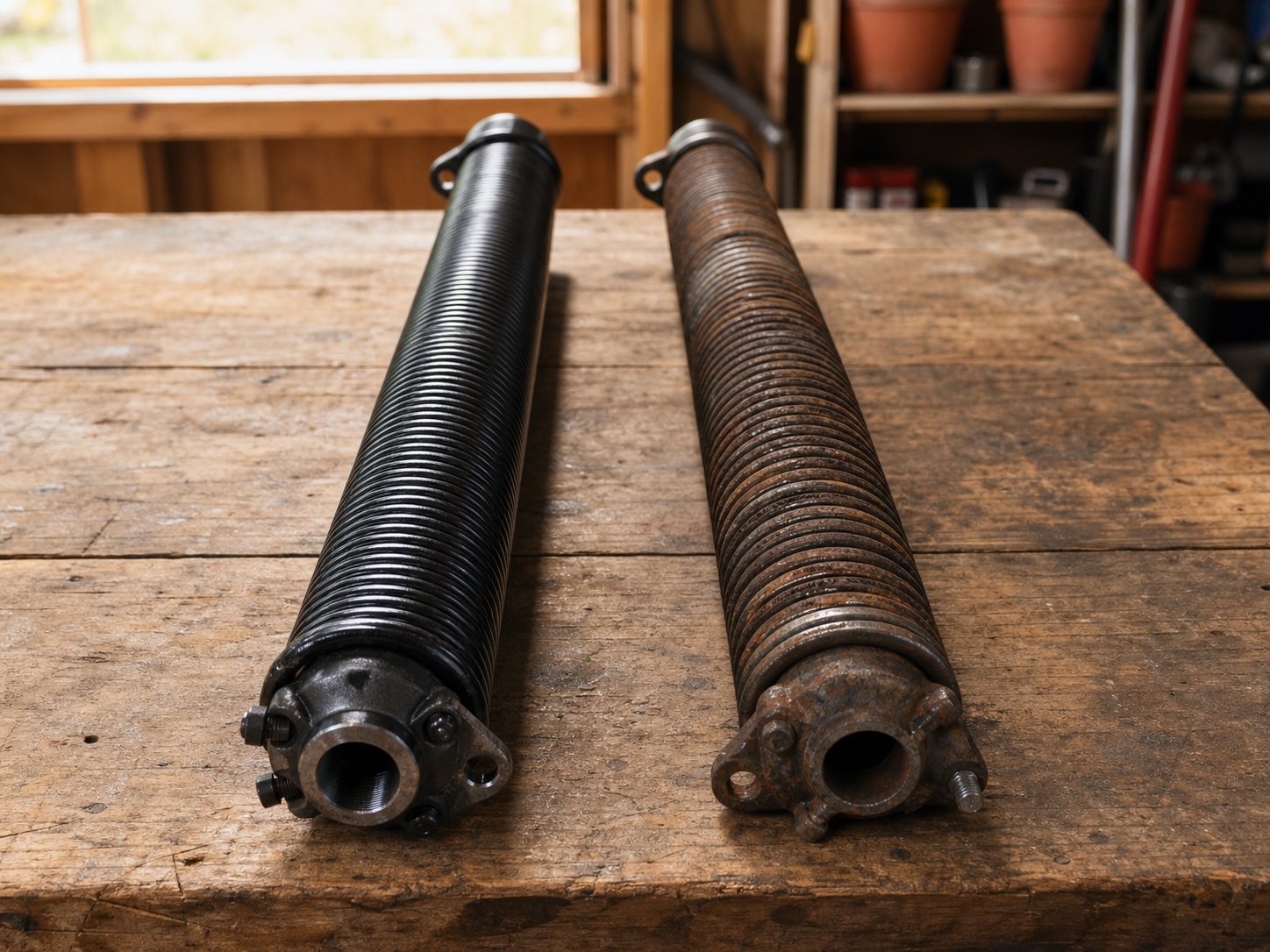
Most modern Chicago garages use torsion springs, the ones mounted horizontally on a shaft above the door. They are more durable, hold balance better, and do not whip dangerously if they fail. If your garage still runs the older extension springs, the long springs stretched along each horizontal track, the rule of two applies just as strictly. Extension springs are installed as a matched pair and share the load, so a mismatched pair pulls the door crooked. If yours are the extension type, confirm they have safety cables threaded through them, because a failed extension spring without a containment cable is a genuine hazard in a family garage.
For our Chicago winters we usually steer homeowners toward a torsion setup and, when the budget allows, a high-cycle upgrade. A high-cycle torsion spring is rated for 25,000 cycles or more, which stretches its life to fifteen or twenty years for the extra fifty to a hundred dollars. On a door your family uses every single day through the salt, slush, and cold, that upgrade usually pays for itself before the standard spring would have failed.
When replacing one is genuinely fine
There are honest exceptions, and a good technician will tell you about them. If your door is a true single-spring torsion system, there is only one spring, so you replace it and you are done. If both springs were installed recently and one failed from a manufacturing defect rather than age, the surviving spring may have real life left, though most shops will still recommend matching them. And if you are selling the house next month, a single-spring repair to pass inspection can be a reasonable short-term call.
Those are narrow cases. On a typical older garage in Evanston, Skokie, or anywhere in the bungalow belt where both springs have quietly logged a decade together, doing both is the decision that saves money and a second breakdown.
How to tell an honest quote from an upsell
A trustworthy quote explains the why, not just the number. Ask the technician what the cycle rating is, how old your current springs look, and whether the door passes a balance test after the work. A real pro will unclip the door from the opener, lift it by hand to waist height, and let go. A balanced door holds. A door that slams down or shoots up is telling you the spring tension is wrong.
Watch for the opposite red flag too: a company that quotes a whole new door when a $400 spring pair would fix it, or a lowball single-spring price that leaves off the trip and diagnostic until the invoice. Transparent pricing, a written balance-test result, and a technician who takes two minutes to show you the worn coil are the signs you are dealing with a straight shooter. You can see the kind of work we stand behind on our recent Chicago projects, and a little more about who we are on our about Windy City Garage page.
The bottom line for a Chicago homeowner
One spring broke. The other is the same age, the same batch, and carries the same cycles, so it is not far behind. Replacing both in one visit costs less than two separate repairs and keeps your door balanced, which protects the opener, the lift cable, and the drum. Replace one only when the door genuinely has a single spring or you have a specific short-term reason. Everything else is just paying the trip charge twice.
If a spring has already let go, keep the opener off, pull the manual release, and get a straight quote before anyone touches the shaft. For more homeowner breakdowns like this one, browse more from the Journal, or read up on our full range of Chicago garage door services.
Frequently asked questions
How long do garage door springs last in Chicago?
A standard torsion spring is rated for about 10,000 cycles, which is roughly seven to ten years for an average household. Our freeze-thaw winters and garage humidity shorten that, so many Chicago springs fail on the first hard cold snap after about seven years. A high-cycle spring rated for 25,000 cycles can last fifteen to twenty years.
Is it really necessary to replace both springs if only one broke?
On a two-spring torsion door, yes, in almost every case. Both springs were installed together and have taken the same number of cycles, so the surviving spring is at the end of its life too. Replacing both in one visit costs less than two separate service calls and keeps the door balanced, which protects your opener and cables.
Can I keep using the opener with a broken spring?
No. With a broken spring the door carries its full dead weight, often well over a hundred pounds, and forcing the opener to lift it burns out the motor. That can turn a spring repair of around $250 into a $600 opener replacement. Stop pressing the button, pull the manual release cord, and leave the door down until a technician arrives.
What does it cost to replace both garage door springs near Chicago?
In 2026 a torsion spring pair with parts and labor typically runs $300 to $500 across the city and North Shore, with the higher end inside Chicago proper where labor costs more. A high-cycle upgrade adds $50 to $100, and emergency or after-hours service adds $75 to $125. A single spring alone runs $180 to $280.
One spring down? Get a straight answer first.
We will inspect both springs, run a real balance test, and give you a transparent quote with no surprise line items.
