Illinois joined California in requiring battery backup on garage door openers installed in new residential construction and opener replacements. The law took effect for new construction; replacement openers in existing homes should comply when being installed by a licensed contractor.
We’ve gotten a lot of questions about this, so here’s a plain-language explanation of what the law covers, what battery backup actually does, and whether your current opener needs an upgrade.
What the law actually says
The Illinois Residential Code now requires that garage door openers installed as part of new construction or as a replacement in any attached garage must include a battery backup system capable of operating the door during a power outage.
The key trigger is “attached garage.” If your garage shares a wall with your living space, a single-family home, townhome, or condo where the garage is part of the building, the requirement applies.
Detached garages (standalone garage buildings separate from the house) are not currently covered under the same requirement, though some municipalities have their own codes that may differ.
Importantly: the law applies to new installations, not to every existing opener in Illinois. You don’t have to rush out and retrofit your current opener by a deadline. But if you’re replacing an opener, or installing one in a new home, it needs to have battery backup.
What “battery backup” actually means in practice
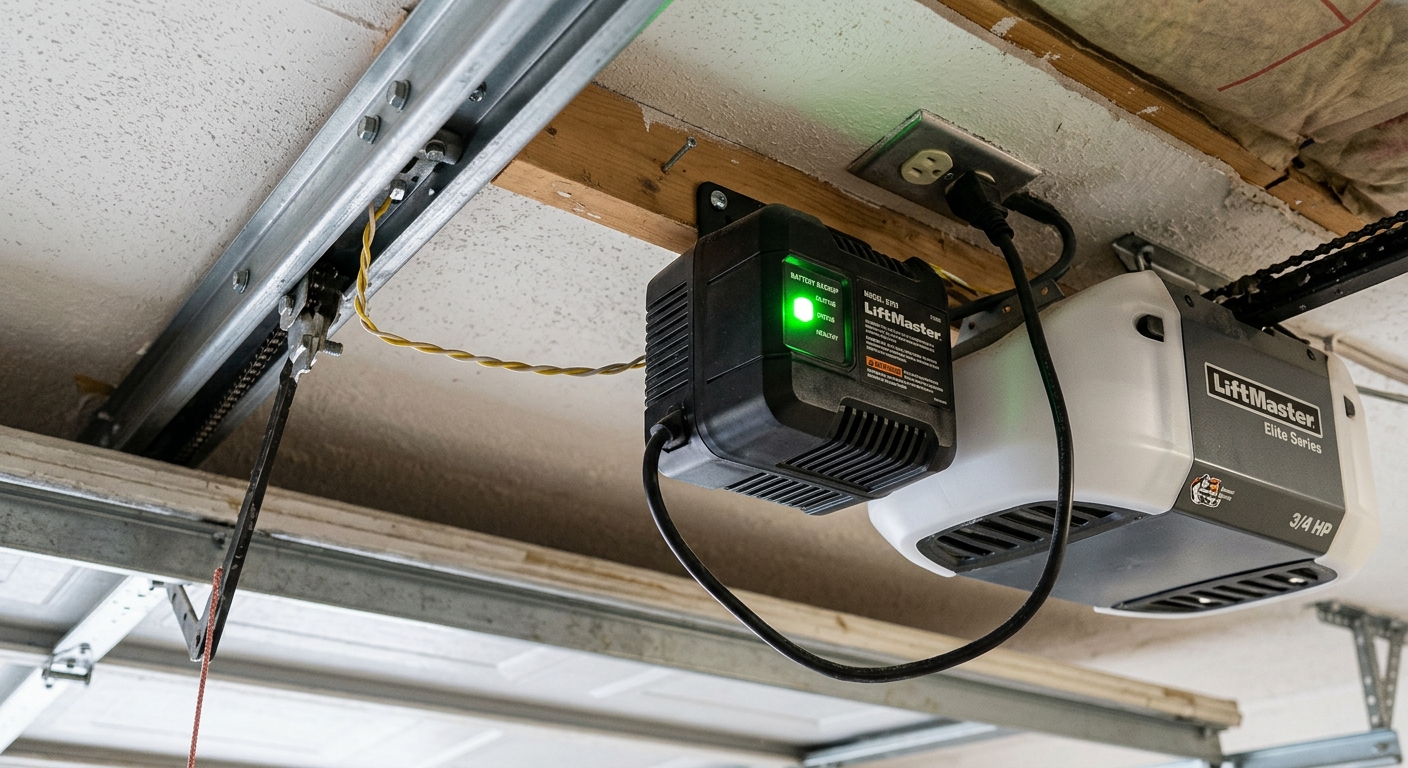
A battery backup system lets your garage door opener continue to operate during a power outage, using stored battery power to run the motor through open and close cycles.
Most battery backup systems integrated into the opener can complete 20 to 50 door cycles on a full charge, depending on the door weight and opener model. At typical residential use (4 cycles per day), that’s 5 to 12 days of operation on battery power alone.
The battery charges continuously from the opener’s electrical connection while power is available. It’s trickle-charging in the background and ready when needed. Most systems include an LED indicator that tells you the battery’s charge state, and an audible alert when the battery drops below a certain threshold.
Why it actually matters in Chicago (beyond the law)
When the law was proposed, I heard people complain that it was regulatory overreach. Having lived through Chicago winters for 50 years and fixed garage doors through every kind of weather event, I think the logic is sound.
Chicago has two weather scenarios where battery backup proves its value every single year:
Summer derecho storms. Chicago gets periodic straight-line wind events that knock out power for neighborhoods for 6 to 18 hours. In July 2023 and again in August 2024, we had widespread outages during extreme heat. Homeowners with no battery backup were stuck, cars in the garage, no way out. In extreme heat, that’s a genuine safety concern.
Winter ice storms. A different problem. Ice storms can take power down for 24 to 48 hours. A homeowner whose car is in the attached garage needs to be able to leave, and in freezing temperatures, manually operating an unbalanced door by hand is risky. Battery backup removes that risk.
In both scenarios, the backup isn’t a luxury. It’s the difference between “inconvenient” and “stuck.”
Which openers already have it built in
You don’t necessarily need a new opener to have battery backup. Several current LiftMaster and Chamberlain models include it natively:
LiftMaster 8500W (wall-mount, jackshaft style): Built-in battery backup, myQ connectivity, designed for low-headroom and side-mount installations. This is our most common recommendation for Chicago homes with limited headroom above the door.
LiftMaster 84505R (belt drive, Wi-Fi): Built-in battery backup standard, full myQ integration, LED lighting. Our go-to for standard residential installs.
Chamberlain B6765 (belt drive, Wi-Fi): Battery backup standard, also myQ-compatible. Very similar to the 84505R in functionality.
If you have one of these models already, you’re covered. The backup is already in the opener.
What if your current opener doesn’t have backup?
Two options:
Add-on battery backup kit. For LiftMaster and Chamberlain openers manufactured after 2014 that don’t have battery backup built in, there are add-on kits that install on the motor head. The kit includes the battery pack, a mounting bracket, and wiring harness. Installation is about 30 minutes on most models. The battery charges from the opener’s existing power connection.
Compatibility varies by model. Not all openers accept the add-on kit. Some motor head designs don’t have the correct mounting point or power input. We check compatibility before recommending this option.
Replace the opener. For openers over 10 years old, or openers that don’t support the add-on kit, replacement is usually the better investment. An opener that’s 12 years old has already exceeded its rated duty cycle in most residential applications. Putting a $150 battery backup kit on a motor that needs replacement in 18 months is not the right call.
Cost of the upgrade
Battery backup add-on kit (parts + installation): $180 to $250 depending on the opener model and kit compatibility.
Full opener replacement with battery backup built in (LiftMaster 84505R or equivalent, installed): $450 to $600 depending on door size and whether a rail replacement is needed.
If you’re replacing an opener specifically for the battery backup feature, factor in the full system cost. The LiftMaster 84505R comes with battery backup, myQ Wi-Fi, LED lighting, and a 10-year motor warranty. The total cost is well within the range of what many homeowners spend on a kitchen appliance.
Battery maintenance
The battery in these systems is a rechargeable lead-acid or lithium unit. Like all batteries, it degrades over time.
LiftMaster and Chamberlain recommend replacing the battery backup unit every 2 to 3 years under normal use. The opener will alert you when the battery charge capacity drops below a safe threshold, usually via a beeping pattern or an indicator light on the motor head.
We stock replacement battery units for the common models. Battery replacement is a 10-minute job if you’re comfortable with the opener’s manual; it’s a $50 service call if you’d rather have us do it.
Getting it done
Will Chen, our smart-opener specialist, handles battery backup installations and consultations across Chicagoland. He does a quick phone assessment first, model, age of opener, whether the add-on kit is compatible, before scheduling an install visit. Most installs are done within the week.
Call +1 (312) 418-2970 and ask for smart opener support, or email hello@windycitygarage.com with your opener model. We’ll tell you within the hour what your options are.
