At least once a week, someone calls to report that their spring snapped and they need it replaced. Then I ask, “Which spring, torsion or extension?” And I get silence.
Most homeowners have never looked at their garage door’s spring system. They know there’s something up there that helps the door move; they don’t know what kind it is or how it works. That’s fine, you shouldn’t need to know. But when a spring fails, it helps to understand what you’re dealing with.
Here’s how to tell them apart, what each does, and when you might want to upgrade from one to the other.
Torsion springs: above the door, horizontal
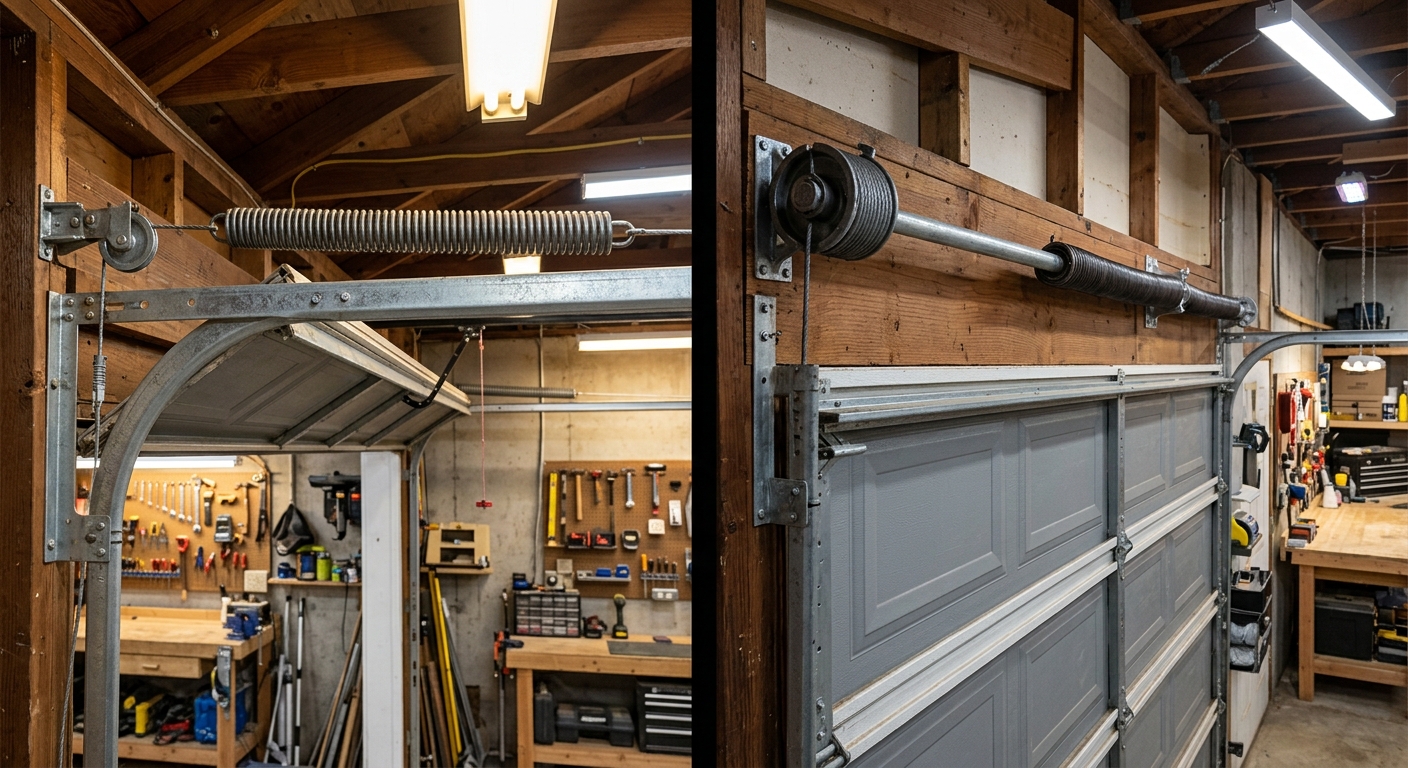
Look at the wall above your garage door, not the tracks on the sides, but the horizontal header above the door opening. If you see a tightly coiled steel spring mounted on a steel shaft running across the width of the door, you have a torsion spring system.
On single-car doors, there’s usually one torsion spring centered on the shaft. On two-car doors, there are typically two springs, one on each side of the center bracket.
How it works: When the door closes, the spring is wound tighter, storing energy in the coil. When the door opens, the spring unwinds, releasing that energy through the shaft and cable drums to lift the door. The counterbalance is smooth and controlled, the shaft distributes the load evenly across both sides of the door.
Torsion springs are the standard on most doors installed after the mid-1990s. They’re more efficient, longer-lasting, and safer than extension springs.
Extension springs: above the horizontal tracks, on the sides
If you see long springs, not coiled tight but visibly stretched lengthwise, running along the upper horizontal tracks on each side of the door, you have extension springs.
Extension springs work differently from torsion springs. As the door closes and descends, these springs stretch and store energy in that tension. When the door opens, they contract, and that pull is what lifts the door through a pulley system.
Extension springs are common on older doors and in garages with low headroom, where there isn’t enough clearance above the door for a torsion shaft and spring assembly.
Which is safer?
Torsion springs.
When a torsion spring breaks, it’s dramatic. There’s a loud bang, the door drops, and the coil may have a visible gap. But the broken spring stays on the shaft. The energy releases through the coil structure rather than flying across the garage.
When an extension spring breaks, it can whip. Extension springs under tension are essentially a wound-up elastic under load. A broken extension spring without a safety cable can fly 20 feet across the garage and cause serious injury.
DASMA (the Door and Access Systems Manufacturers Association) recommends that all extension spring systems have safety cables running through the center of the spring, a secondary cable that catches the spring if it snaps. If you have extension springs and can’t see safety cables running through them, that’s a safety issue worth addressing now.
Which lasts longer?
Torsion springs, by a significant margin, especially in Chicago.
Standard extension springs: 10,000 cycles rated life. Standard torsion springs: 10,000 cycles rated life. High-cycle torsion springs (what we install): 25,000 to 30,000 cycles rated life.
At four cycles per day, 10,000 cycles is about 6.8 years. Our high-cycle torsion springs will last 17 to 20 years under the same usage, even in a Chicago climate.
The spring cost difference at installation is modest. The labor, inconvenience, and potential damage of a mid-life failure is not.
Can you upgrade from extension to torsion?
Yes, in most cases, and it’s often worth doing.
To switch from extension to torsion, we need:
- At least 2 inches of headroom above the door for the spring shaft and end brackets
- The door weight (usually stamped on the door or the original spring) so we can size the replacement spring correctly
- Removal of the existing extension spring hardware and pulleys
The conversion runs roughly $350 to $550 depending on door size and whether the cable system needs to be replaced at the same time. If you’re replacing extension springs anyway, the upgrade cost is usually only $80 to $150 more than a like-for-like replacement.
If your garage has extremely low headroom (less than 2 inches above the door), a standard torsion shaft won’t fit. In those cases, we use a low-headroom torsion bracket system, or we keep extension springs and install safety cables.
Signs your extension springs are failing
Extension springs give clearer visual warnings than torsion springs.
Uneven door travel: If the door tilts as it opens or one side appears to move faster than the other, an extension spring on one side may be losing tension.
Visible coil separation: Extension spring coils should be tight and uniform. Gaps, kinks, or a section that looks pulled-out are signs of fatigue.
Rust along the coil: Light surface rust is cosmetic, but deep pitting or flaking rust is structural. Rust removes metal from the wire cross-section and reduces the spring’s rated strength.
Longer open time: If the door takes noticeably longer to open than it used to, the springs are losing their stored energy capacity.
Signs your torsion springs are failing
Same basic principle, different visual:
Gap in the coil: The most obvious sign. Stand safely back and look at the torsion spring. Any visible gap between two adjacent coils means the spring is broken or severely fatigued.
Door opens slowly or unevenly: The opener is compensating for lost spring tension.
Grinding or clicking from the spring area on open/close: Not a lubrication problem. This is a structural warning sign.
Not sure which type you have, or whether yours is close to failing? Call us and describe what you see. We can usually tell you over the phone whether it’s urgent and give you a ballpark cost before we roll a truck. +1 (312) 418-2970.
