In late January, the calls come in before 7 a.m.
Tuesday morning last winter: Logan Square homeowner, minus-14 wind chill, door won’t open. Spring snapped sometime overnight. Car’s in the garage. She’s got a 7:45 meeting downtown. I’ve had this call, or a version of it, maybe three hundred times.
Cold weather doesn’t break springs randomly. There’s a very specific reason it happens, and once you understand it, you’ll know exactly what to look for before yours goes.
What a torsion spring actually does
Most homeowners think the opener lifts the door. It doesn’t, not really.
The torsion spring does the lifting. It’s a tightly wound coil mounted on a steel shaft above the door. When the door closes, the spring winds up and stores energy. When you open the door, it unwinds and releases that energy, which is what actually raises the door’s weight. Your opener is just handling the last 10 to 15 percent, the part the spring can’t quite manage on its own.
A standard residential garage door weighs between 150 and 250 pounds. Without the spring doing its job, your opener would burn out in a week. The spring is doing the real work every single time.
Why cold weather breaks springs faster
Steel loses elasticity in the cold. Below 32°F, galvanized steel, the kind your spring is made from, becomes more brittle at the molecular level. The metal that used to flex and absorb stress without complaint now wants to crack instead.
Here’s the compounding problem: in a Chicago winter, your spring is working harder at the same time it’s getting weaker. Cold weather causes the spring to tighten slightly as the metal contracts. That added tension means every open-close cycle is putting more stress on the coil than it would in July.
Add a January ice storm, where the door might freeze briefly to the threshold and require extra force to break free, and you’ve got a spring being yanked past its rated cycle load in sub-optimal conditions.
This is why I can set my calendar by spring calls. They cluster in January and February, with a smaller spike in early March when temperatures swing hard between warm days and overnight freezes.
How long they typically last
A standard 10,000-cycle spring in a Chicago climate usually gives out somewhere around five to seven years. High-cycle springs, rated for 25,000 cycles, tend to last roughly twice that in the same conditions.
That range assumes a garage that opens and closes about four times a day, twice in and twice out. If you have teenagers, a home office, or a two-car household, your cycle count is higher and your springs will fail sooner.
Most homeowners have no idea what springs they have or when they were last replaced. If you moved into your home more than six years ago and the springs haven’t been touched, they’re living on borrowed time.
What to do when the spring snaps
First: do not try to force the door open manually.
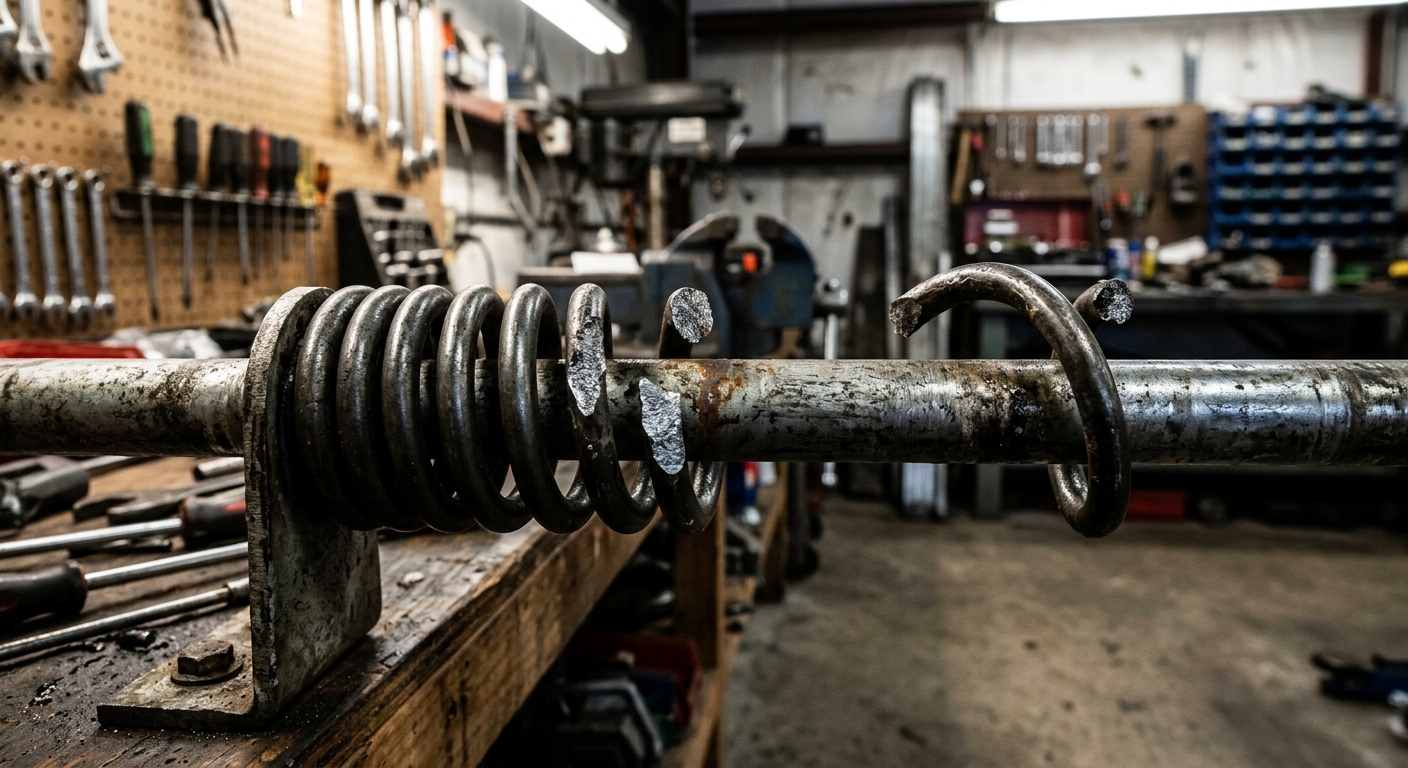
When a torsion spring breaks, the door loses its counterbalance. It now weighs its full 150 to 250 pounds with nothing helping lift it. Forcing it open by hand risks dropping it on you, stripping the opener’s motor, or shearing the cable off its drum, turning a $300 spring repair into a $700 cable and panel job.
Do not disengage the opener and try to lift manually. Do not use a pry bar. Do not try to MacGyver it with a rope.
If the door is stuck open, you’ve got a security problem. Call us and we’ll get there same day. If it’s stuck closed and you need your car, call us and we’ll get there same day. These are not fix-it-yourself situations.
Why we always replace springs in pairs
If you have two torsion springs (most two-car doors do) and one breaks, the other is at essentially the same number of cycles. They were installed at the same time, under the same conditions, and have experienced the same wear.
Replacing just the broken one means the intact spring will fail within months, sometimes weeks. You’ll pay another dispatch fee, another labor charge, and go through another morning of a car stuck in the garage.
We always replace in pairs. It costs less overall and gives you a matching warranty clock on both sides.
What we use, and why it matters
Not all springs are the same. The cheap galvanized springs you can find at a hardware store are rated for 10,000 cycles. That sounds like a lot, and it is, for a single spring in a mild climate. In Chicago, with four cycles a day and winter stress, you’ll burn through 10,000 cycles in about seven years.
We install lifetime-rated springs: high-cycle galvanized wire, rated for 25,000 to 30,000 cycles. These cost more upfront and come with a lifetime warranty. We also balance the spring on-site with a level and a cycle test before we leave, because a new spring that’s wound incorrectly will fail early and put uneven stress on your cables.
The springs we install meet DASMA (Door and Access Systems Manufacturers Association) standards. That’s the industry benchmark. If a company doesn’t mention DASMA ratings, ask.
How to know yours is close
You don’t have to wait for a snap. There are three warning signs you can see from the ground:
Slow opening: If your door has started opening noticeably slower than it used to, especially in cold weather, the spring is losing tension. The opener is compensating, which stresses its motor. This is the first sign.
Visible gap in the coils: Look at the spring from a safe distance (don’t touch it). A healthy spring has tightly wound coils with no visible gaps. If you see daylight between any two coils, the spring is already fatigued. Don’t wait for the snap, call us.
Grinding or popping noise: A spring that’s close to failing often makes noise it didn’t make before. A rhythmic pop or metallic grinding during opening isn’t a lubrication problem, it’s a structural warning.
If you’re seeing any of these, schedule a tune-up. We’ll assess the spring cycle count, test the balance, and tell you honestly whether replacement is urgent or can wait. Most tune-ups are $129 flat, and we often catch spring failures before they become 6 a.m. emergencies.
Same-day spring replacement across Cook, DuPage, and Lake counties. No weekend surcharge. Call us at +1 (312) 418-2970.
