Every January I get the same call, and I mean the exact same call: “My opener is dying. It grinds, barely lifts the door, and sometimes just stops halfway.”
Nine times out of ten, the opener is fine. The spring balance is what’s off.
Here’s what’s actually happening, and what you can do about it before you need to call us.
Why your opener labors in January
Your garage door opener is not designed to lift your door. It’s designed to move a door that’s already balanced.
A properly balanced door, with springs in good condition, should weigh about 8 to 12 pounds of effective lift load on the opener. The springs counterbalance the rest. So your opener is really just handling about 5% of the door’s total weight.
When temperature drops below 20°F, torsion springs lose tension. The metal contracts and the pre-wound torque decreases. A spring that counterbalanced 240 pounds in September might be handling 210 pounds in January. That extra 30 pounds falls on the opener’s motor.
Add the fact that lubricants thicken in cold weather, rollers get stiff, and weather seals compress and add friction, your opener is fighting a door that’s noticeably harder to move than it was three months ago.
The myth about “my opener is dying”
Most openers we replace in winter are perfectly functional. They just got burned out from months of overcompensating for worn springs.
The thermal overload protector inside your opener trips when the motor runs too hot. When it does, the opener stops mid-cycle and won’t restart for 15 to 30 minutes. Homeowners interpret this as a dying motor. Usually it’s a spring that needs attention.
The right diagnosis matters. A new opener costs $400 to $600 installed. A spring balance adjustment costs $129 (our tune-up rate). Don’t replace the opener if the spring is the problem.
The one-inch lift test
Before calling a tech, do this test:
- Disconnect the opener by pulling the red emergency release cord.
- Manually lift the door to waist height (about 3 feet).
- Let go carefully.
A properly balanced door will stay put, or drift very slowly. If it falls immediately, your springs are under-tensioned, probably from cold weather. If it shoots upward, they’re over-tensioned. Either condition means the opener is doing extra work every cycle.
Do not adjust the spring tension yourself. Spring winding requires winding bars and specific torque training. The spring stores enough energy to cause serious injury if it releases uncontrolled. Call us. But this test tells you whether the opener or the spring is the actual problem.
The torque adjustment (what we actually do)
On a service call for winter opener issues, the first thing we do is check spring balance with the test above. If the balance is off, we re-tension the springs to factory spec for the door weight. That’s typically done with a quarter-turn or half-turn adjustment using winding bars.
After re-tensioning, the door usually reopens with the opener running quieter and smoother than it has in months. The fix takes about 20 minutes and costs far less than a new opener.
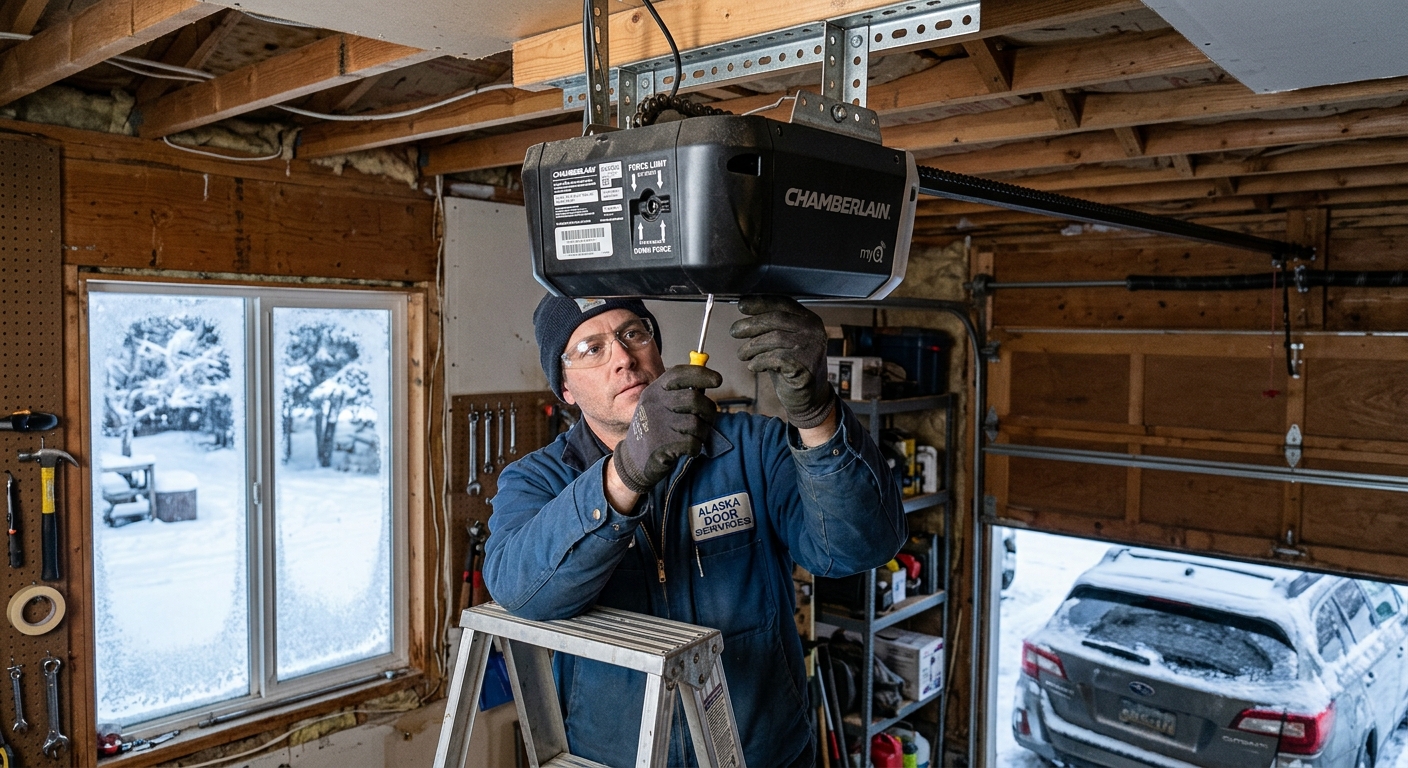
We also check the opener’s force settings, the adjustment that controls how hard it pushes or pulls. In cold weather, some openers benefit from a slight force increase. This is done with a small adjustment screw on the motor head. The manual has a diagram. But again: adjust force only after confirming spring balance is correct.
Cold-weather lubrication that actually works
If you do one thing before the first polar vortex, do this: lubricate your garage door correctly.
Not WD-40. WD-40 is a solvent-based product designed to displace water and loosen rust. It evaporates, leaves no lasting film, and actually attracts dirt. Don’t use it on springs, rollers, or hinges.
Not silicone spray on the metal tracks. Silicone is great for some applications, but it makes metal tracks slippery in ways that can cause rollers to skip.
Use white lithium grease on:
- Torsion spring coils (a thin coat along the length of the coil)
- Roller stems where they enter the hinge bearing
- Hinge pivot points
- Bottom bracket pivot points
A light coat of 3-in-1 garage door oil works well on roller bearings specifically. Apply it, run the door through three full cycles, and wipe off the excess.
Do not lubricate the tracks themselves. The rollers ride inside the C-channel; the track doesn’t need lubrication, it needs to be clean.
The 20-second winter check
Before the first hard freeze every year, walk through these five things:
- Spring gap check: Look at your torsion spring(s) from the floor. Any visible gap between coils means the spring is fatigued. Schedule service.
- Balance test: Disconnect the opener, lift door to waist height, let go. It should stay.
- Lubrication: White lithium grease on springs and hinges. Takes 10 minutes.
- Weather seal: Press your hand along the bottom seal when the door is closed. Cold air coming through means the seal needs replacement.
- Reverse test: Place a 2×4 flat on the floor under the door. Close it. It should reverse when it hits the board. If it doesn’t, the close-force is set too high. That is a safety issue.
When the problem is not the cold
Cold-weather stress reveals underlying problems more than it creates new ones. These symptoms mean something else is wrong:
Door reverses on its own without hitting anything: The opener’s limit switch may need adjustment, or a safety sensor is misaligned. Check that both sensors on the bottom of the door frame have solid green/yellow lights.
Motor runs but door doesn’t move: The drive gear or trolley has likely stripped. Common on chain-drive openers over 10 years old.
Opener beeps five times before refusing to close: This is a safety sensor fault, almost always a misaligned sensor or bad wiring at the sensor, not the motor.
Any of these means the opener itself needs attention, not just the springs. Give us a call and we can usually diagnose by phone before rolling a truck.
Annual tune-up from $129 flat. We inspect springs, balance the door, lubricate, test the opener, and leave you a written condition report. Book at +1 (312) 418-2970 or via our contact page.
