The most common post-fender-bender call we get starts like this: homeowner backed a car into the garage door, one panel is dented, and they’ve already called their insurance company. The insurance adjuster told them they need a new door. They’re calling us to schedule the replacement.
Half the time, they don’t need a new door.
Here’s how to think about panel replacement, when it makes sense, when it doesn’t, and how to handle the insurance side of it.
How sectional doors are actually built
A standard residential garage door is made of horizontal sections, usually four to six panels stacked on top of each other, connected by hinges at the joints. Each panel is a structural unit. They’re connected but independent.
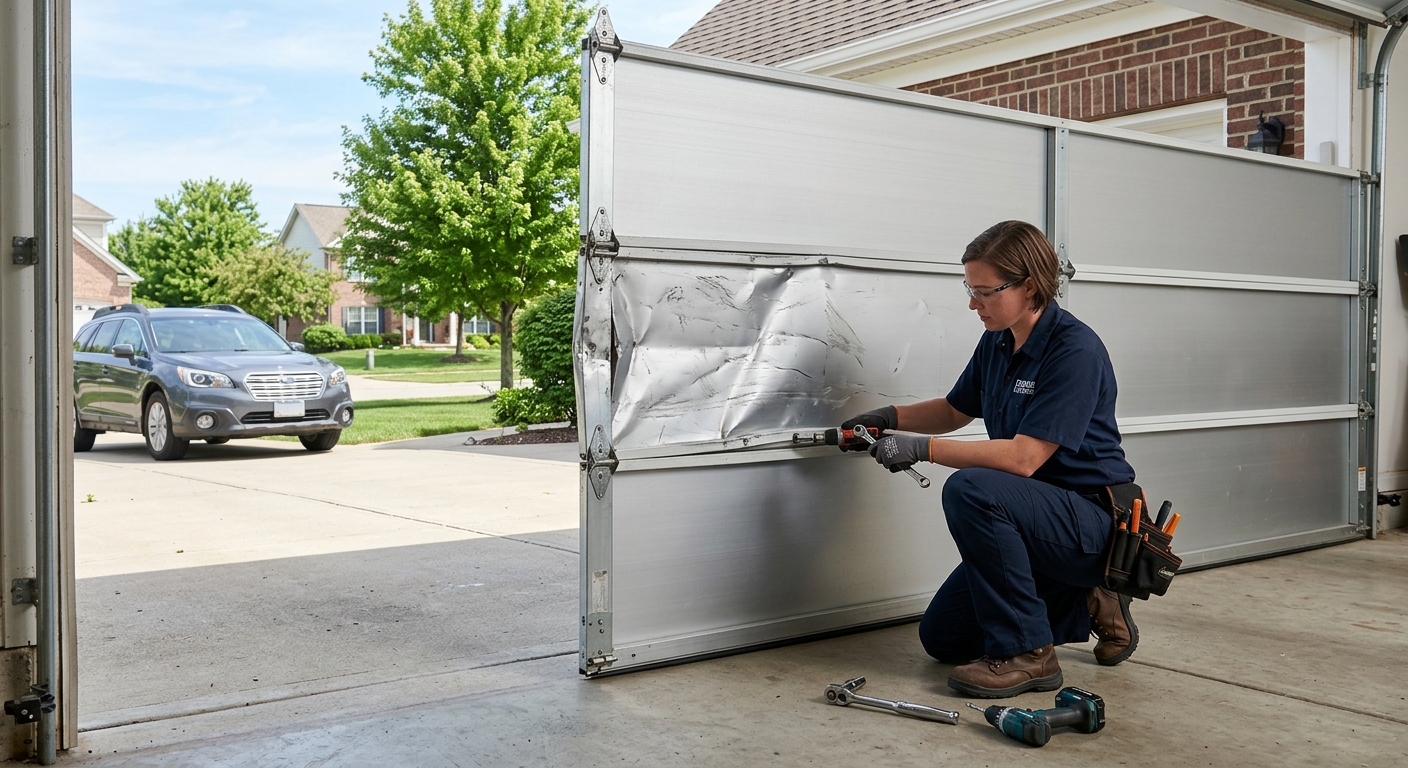
This matters because: you can remove one section and install a replacement without touching the rest of the door. You don’t have to tear down the whole door, dispose of it, and install a new one. In most damage scenarios involving a vehicle impact, only one or two sections actually take the hit, the ones at bumper height.
Panel replacement has been standard practice in the industry for decades. It’s faster than a full door replacement, costs significantly less, and leaves you with the same door you had minus the dented section.
When single-panel replacement is the right call
Four criteria need to be true for panel replacement to make sense:
1. One to two sections are damaged. If three or more sections took the impact, the structural math starts favoring replacement. More sections means more labor, more individual panels to match, and more hidden damage to find.
2. The door frame is intact. The vertical steel frame that holds the tracks to the wall needs to be straight. If the impact pushed the frame inward or cracked the header, you’re not just replacing a panel, you’re doing structural work. We check this with a level on every panel replacement call.
3. The door is under 15 years old. Panel replacement requires sourcing a matching panel from the manufacturer. Most manufacturers support their panel inventory for 10 to 15 years after a model is discontinued. For a newer door, matching is almost always possible. For a door made in 2005 that used a manufacturer who’s since been acquired twice, that panel may simply not exist anymore.
4. The spring and cable system is in good condition. This is the check most people don’t think about. We always inspect the spring balance on a panel replacement call. If the spring is close to failure, it doesn’t make sense to put a $450 new panel on a door with a spring that’s going to snap in six months. We tell you before we do the work.
When you actually need a new door
Some impact scenarios take a panel replacement option off the table:
Multiple sections damaged, track frame bent. When the impact pushed the door hard enough to bend the galvanized steel track or deform the horizontal track hardware, the whole door system needs to be assessed. A bent track causes off-track failures and roller wear that will cost you more in six months than a replacement would have today.
Bottom rail compromised. The steel bottom rail is the structural base of the door. It holds the bottom weather seal, connects to the lift cables, and provides rigidity to the bottom section. If it’s kinked, cracked, or deformed, the entire bottom section needs replacement, and if that section is the heaviest insulated section on an older door, you may not find a match.
Door is over 20 years old. Beyond the panel matching problem, an older door has springs, cables, rollers, and hinges that are all at or past their rated service life. Putting money into a 20-year-old door is often the wrong call.
Insulation destroyed. Modern steel doors have polyurethane foam insulation bonded to the interior face of each panel. If the foam core is cracked, compressed, or delaminated from the panel skin, the panel loses most of its R-value. You can install a matching panel face, but you’ll be putting new siding on a damaged insulation core.
The matching problem
This is what determines whether single-panel replacement is feasible, and it’s worth explaining honestly.
Matching a panel requires knowing:
- The door manufacturer (Clopay, Amarr, Wayne Dalton, CHI, etc.)
- The model and product line within that manufacturer’s catalog
- The panel height and width
- The finish (embossed pattern, smooth, carriage-style) and the specific profile
- The color, and for painted doors, the paint code
Most manufacturers stamp their name somewhere on the door, and most model information is in the original paperwork or stamped on the spring drum. We can usually identify a door by looking at it; we’ve handled enough of each major brand to recognize the panel profile.
Where it gets complicated: paint fading. A door that’s been in the Chicago sun and freeze-thaw for eight years has a different color than a fresh panel from the manufacturer. We’ll tell you if the color match is going to be noticeably off, because we’d rather you make an informed decision than discover it when we bolt the panel in.
What it costs, honestly
Panel replacement (1 section, standard residential steel): $250 to $450 depending on the panel size and whether it’s a base or insulated model. This includes labor, hardware, and a balance test.
Full door replacement (standard residential, insulated steel, installed): $1,500 to $2,800 depending on door size, insulation level, and opener situation.
If you’re replacing a 2-car insulated door with a carriage-style design and a premium finish, figure $3,500 to $5,500. That’s a different market.
The panel repair vs. replacement decision is usually clear from those numbers. One damaged section: repair. Three damaged sections on an older door: we’ll probably recommend replacement and explain why.
The insurance angle
Most homeowners insurance covers vehicle-caused garage door damage under the comprehensive or dwelling section of the policy, subject to the deductible. The question is whether to file a claim at all.
Our rule of thumb: if the repair is less than $500 over your deductible, pay out of pocket. Filing a claim for $200 of net benefit is not worth the premium impact.
If it’s a major repair, full door replacement, frame damage, or a situation where the panel can’t be matched, file the claim. In those cases, we document everything with photographs, provide a detailed written estimate, and can speak directly to your adjuster if needed.
For claims, insurers almost always want two or three competing estimates. We’ll give you ours in writing, and we’ll be honest about what’s actually damaged versus what an adjuster might try to include or exclude.
Send us a photo of the damage via email at hello@windycitygarage.com and we’ll tell you within an hour whether it looks like a panel or a full replacement, no truck roll required to get a preliminary answer. For in-person estimates: +1 (312) 418-2970.
