This post is from Jamal Thompson, our commercial repair lead. Jamal manages maintenance contracts for warehouses, auto shops, and dock facilities across Chicagoland.
A commercial roll-up door going down costs money in ways that aren’t obvious until it happens to you.
I’ve been called to warehouses where a single failed door stopped a full day of outbound shipping. I’ve seen body shops lose eight hours of production because the service door jammed open in January and the space was too cold to work in. I’ve done emergency dock leveler repairs at 11 p.m. because a facility manager didn’t want to miss a morning shift.
The single consistent thread in every one of those calls: the door hadn’t been maintained. Not neglected out of carelessness, just not systematically maintained, because no one had thought about it until it stopped working.
Here’s the schedule we use on the maintenance contracts we manage. It’s what I’d tell any commercial facility manager to do whether they hire us or not.
Why commercial doors fail faster than residential
Commercial roll-up doors operate in conditions residential doors never see.
Cycle count is the big one. A residential garage door opens and closes four to six times per day. A commercial service door at a busy shop or loading dock might cycle 50 to 100 times per day. At 75 cycles per day, a standard commercial spring rated for 100,000 cycles has a theoretical life of about three and a half years, and that’s under normal conditions, without cold-weather stress, salt exposure, or impact damage.
Chicago makes it harder. Alley and loading dock environments get road salt, vehicle exhaust, oil, and moisture into the door mechanism every day. A spring that might last four years in a climate-controlled environment may fail in two and a half years in a Chicago alley in continuous commercial use.
Add the fact that most commercial operators have higher consequence for a failure (a dock that can’t receive or ship is a direct revenue problem), and you understand why a proactive schedule matters more here than in a residential setting.
Monthly: what your staff can do in 15 minutes
These checks don’t require a tech. Any facility staff member can do them:
Listen to the door cycle. Run the door through two full open-close cycles. You’re listening for new sounds: grinding, squealing, banging, or chattering that wasn’t there last month. New noise means something has changed. Log it.
Check the travel limit on both directions. The door should open fully and stop cleanly at the top. It should close fully and seal against the floor. If it stops short, reverses unexpectedly, or gaps at the bottom, the limit switches or the floor seal need attention.
Visual check on spring and cable. From a safe distance, and without touching anything under tension, look at the coil spring (typically mounted above the door on a horizontal shaft) and the cables on each side. Any visible gap in the spring coil, or any fraying in the cable near the bottom bracket, is a schedule-now situation.
Clear the curtain bottom and guides. Roll-up door curtains collect debris, ice, and packing material at the bottom. Clear it before it gets wrapped into the barrel.
Lubrication (if using a motorized operator). Motorized roll-up operators have lubrication points that should be hit monthly at high-cycle facilities. Consult the operator’s manual for your specific unit. Typical points are the worm gear housing, chain or drive belt, and guide bearings.
Quarterly: what a tech visit should cover
This is what we do on a standard quarterly visit under our commercial maintenance agreements:
Spring tension check and cycle count. We check the spring’s current tension against the rated spec for the door weight, and we estimate the remaining cycle life based on the cycle count since last service. If the spring is within 15% of its rated cycle limit, we recommend replacement at the annual service.
Limit switch calibration. Limit switches tell the operator how far to travel in each direction. They drift over time, especially after impact events where a vehicle hit the door or dock bumper hard. Out-of-calibration limits cause over-travel (door hits the floor too hard) or under-travel (door gaps at the bottom).
Weatherseal and astragal inspection. The bottom seal of a commercial door takes constant abuse from forklift traffic, pallet jacks, and vehicle overrides. We measure seal compression and replace when it’s below 60% of original thickness.
Brake test on motorized units. Motorized roll-up operators have a brake system that holds the door in position when the motor is off. We verify the brake engages cleanly and holds under manual load. A slipping brake causes slow door creep that eventually becomes a full-open failure.
Documentation. We photograph the spring condition, record cycle counts, and leave a written condition report on the facility manager’s desk. This matters for insurance purposes and gives you a paper trail if a warranty question comes up.
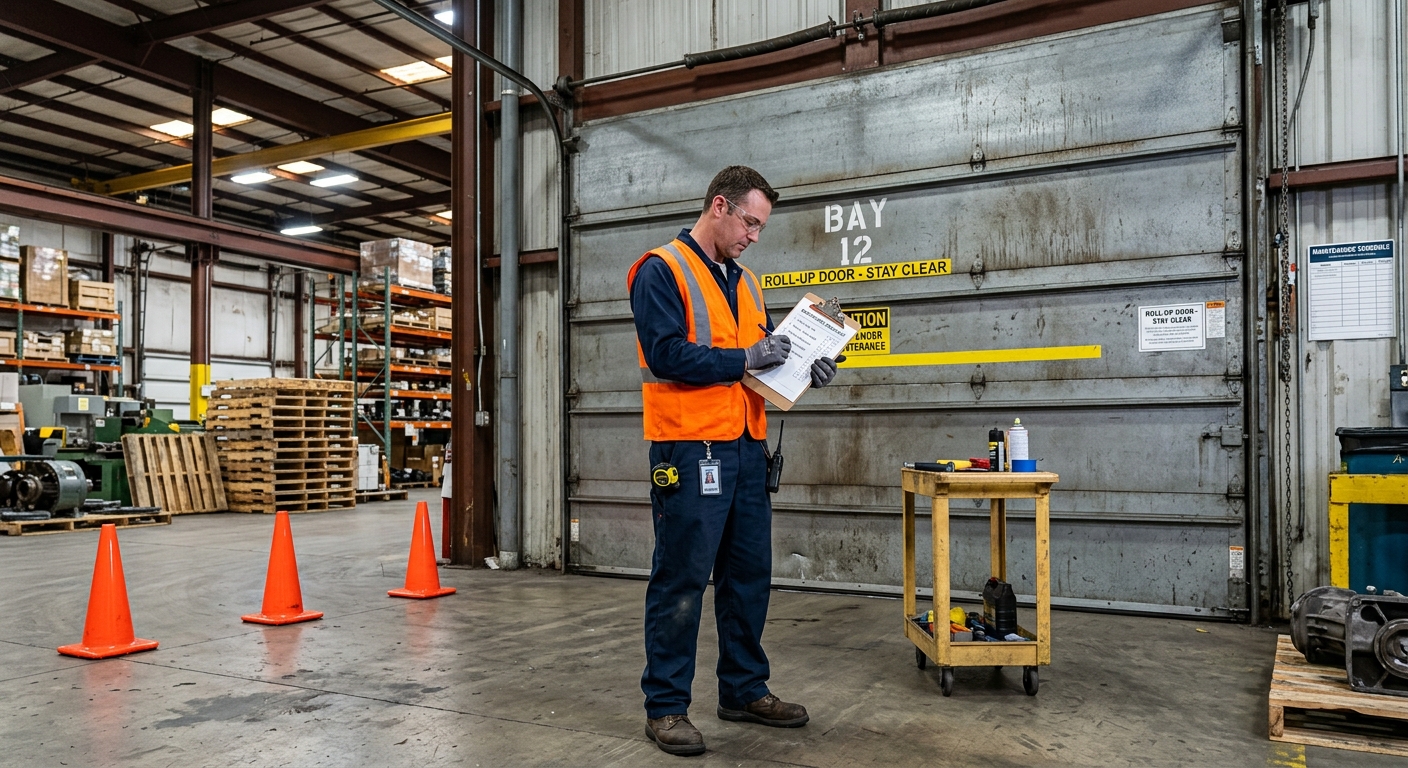
Annual: full teardown inspection
The annual service is where we catch the things that quarterly visits can identify but not quantify.
Full spring and cable replacement if due. Based on cycle count and spring condition, we may recommend replacement at the annual service. We do this as a planned replacement during a scheduled maintenance window, rather than an emergency call at 2 a.m.
Panel rivet and slat inspection. Roll-up door curtains are made from interlocking steel slats connected at the edges. Rivet failure at the slat joints is common in high-impact environments. We inspect each joint and replace failed rivets before they allow a slat to separate.
Fire door drop test (if applicable). If your facility has fire doors, fusible-link or electric-release roll-up doors that close automatically in a fire, they require an annual drop test to verify the release mechanism works. This is an NFPA 80 requirement and an insurance requirement in most commercial policies. We document the test result.
Operator inspection and overhaul. Motor, control board, wiring, terminal strip, limit switches, and emergency release mechanism are all inspected and cleaned.
The contract math for a 5-door facility
Here’s a real-world cost comparison I walked a client through last year. They run a 5-door auto body shop in Pilsen.
Without a maintenance contract:
- Two emergency service calls per year (industry average for 5 commercial doors): ~$800 to $1,200 per call = $1,600 to $2,400/year
- One spring replacement (unscheduled, per failure): $650 to $900 including emergency dispatch
- One full day of lost production (shop closed while waiting for emergency repair): $4,000 to $6,000 in their case
With a maintenance contract:
- Annual contract for 5 doors (quarterly visits + annual service): $1,800/year
- Planned spring replacement (at annual service, no emergency dispatch): $550 to $750
- Lost production days per year: zero (planned downtime during scheduled maintenance window, usually 3 to 4 hours)
The contract also comes with priority dispatch, a 4-hour response window on emergency calls, a parts discount, and we stock that facility’s specific hardware on our truck.
They signed. Most facilities do the math and arrive at the same conclusion.
What we cover
Our commercial maintenance contracts include roll-up service doors (manual and motorized), sectional commercial doors, fire doors (fusible link and electric release), dock levelers, dock seals, and dock bumpers. We don’t handle dock leveler hydraulic systems in-house, but we work with a hydraulic partner for facilities that need that covered.
Contracts are priced per door, per visit frequency, with pricing that scales down as door count goes up. We offer monthly, quarterly, and annual service intervals depending on your cycle count and risk tolerance.
If you run a facility in Cook, DuPage, or Lake County and haven’t thought about your door maintenance schedule, call us for a free site survey. We’ll walk the facility, assess the condition of every door, and give you a recommended schedule and contract price. +1 (312) 418-2970.
